About Chelonoidis chilensis (Gray, 1870)
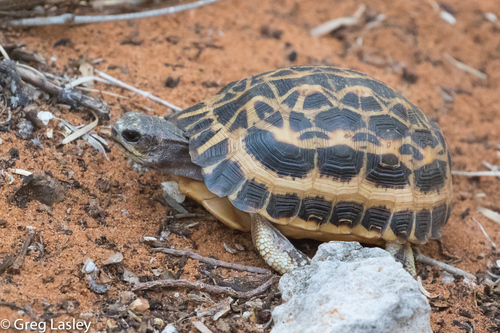
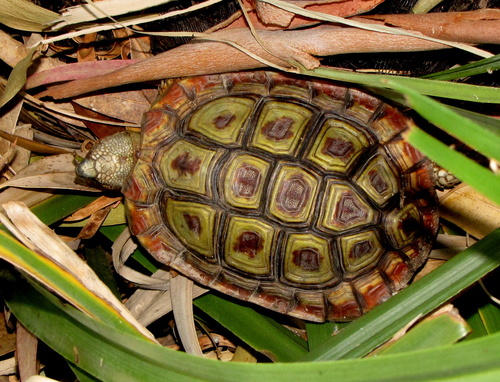
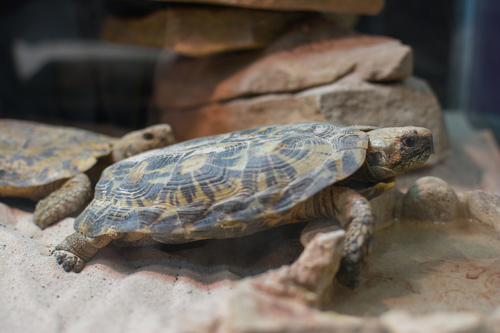
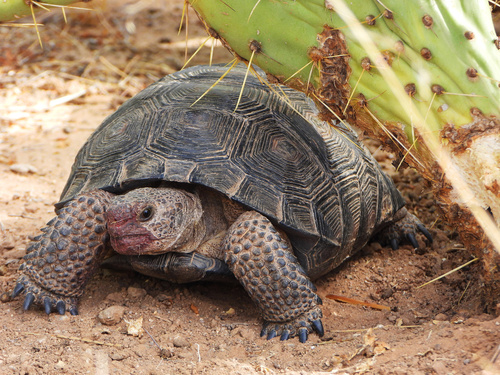
When measured along a straight line, the carapace of Chelonoidis chilensis can reach a maximum length of 43.3 cm, though most individuals grow to less than 25 cm. The carapace may be entirely yellowish brown, or each of its scutes can feature dark-brown to black rings that surround a tan center. Individuals from more southern populations tend to be much larger than members of more northern populations. The edge of the shell is slightly serrated, and each scute has a dark wedge of pigment at its back edge. The plastron may be uniformly yellowish-brown, or it may have a dark triangular wedge along the seam of each scute. The head, limbs, and tail are colored greyish to yellowish-brown. The front of each forelimb is covered in large, angular scales, and each thigh has several enlarged tubercles. This species, commonly called the Chaco tortoise, occurs mainly in Argentina, and also lives in Bolivia and Paraguay. It is found mostly within the Chaco and Monte ecoregions. Its distribution is primarily limited by temperature-related variables, and by precipitation during the reproductive period.