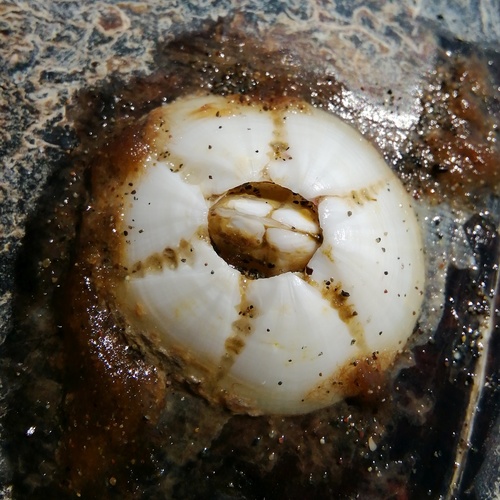
About Chelonibia testudinaria (Linnaeus, 1758)
Compared to the related species Chelonibia patula, which has a conical shell with smooth plates and long cirri IV, V, and VI, and randomly distributed dwarf males that settle directly on its plates, Chelonibia testudinaria has a flatter, less conical shell shape. Its cirri IV, V, and VI are short, and shallow oval depressions are present on the radii at the junctions of its shell plates. Dwarf males of C. testudinaria most commonly settle within these specific depressions. In ecology, Chelonibia testudinaria attaches to the shells or objects of larger host organisms across all regions of a host’s body. This species behaviorally prefers green turtles as hosts. By contrast, the related species Chelonibia caretta prefers Hawksbill sea turtles as hosts. On the shell of a host turtle, the fastest water flow occurs over the front central area. C. testudinaria individuals can relocate across the turtle’s shell, and they usually move toward the optimal position that offers maximum water flow, which provides the greatest filter feeding opportunities. Their movement is around 1.4 mm (0.06 in) or less per day. This movement is probably achieved by advancing the shell forward during each increment of growth. Over the course of several months, this slow movement allows individuals to cross multiple turtle shell scutes.

