About Chelonia mydas (Linnaeus, 1758)
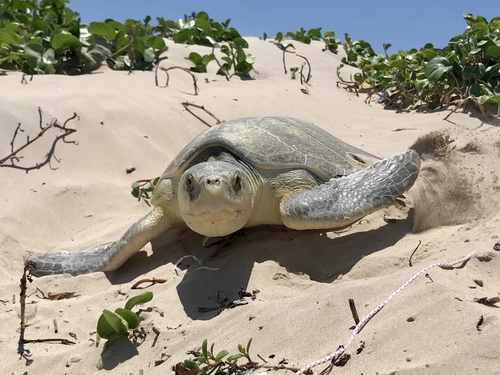
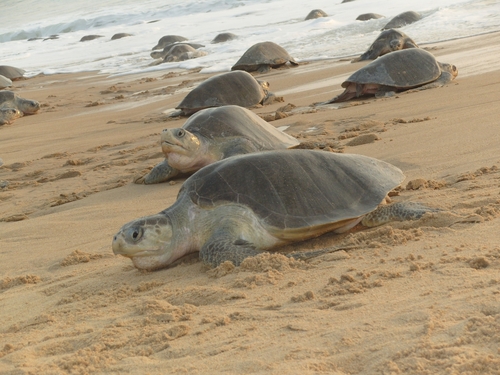
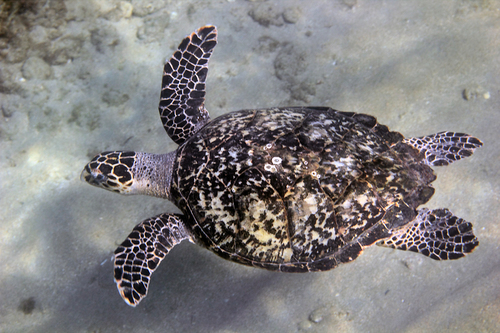
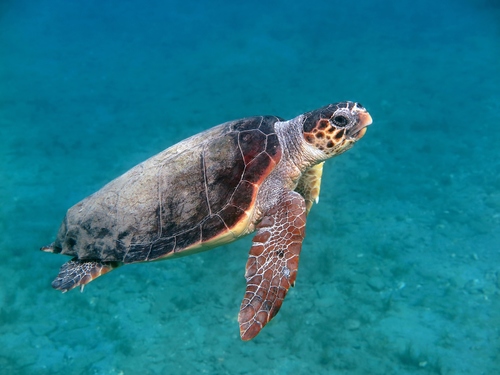
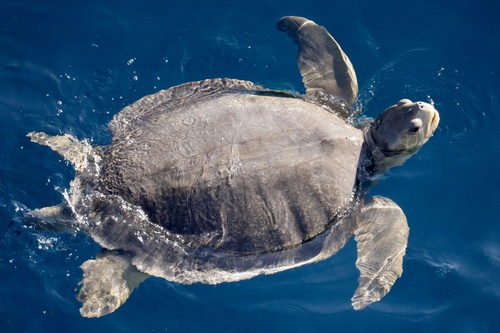
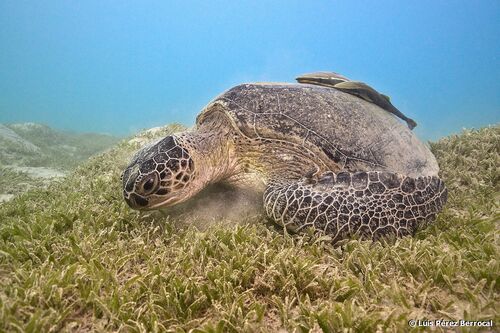
Chelonia mydas, commonly called the green sea turtle, has the general appearance of a typical sea turtle. It has a dorsoventrally flattened body, a beaked head at the end of a short neck, and paddle-shaped arms well adapted for swimming. Adult green turtles reach up to 1.5 meters (5 ft) in total length. Mature individuals have an average weight of 68–190 kg (150–419 lb) and an average carapace length of 78–112 cm (31–44 in). It is considered the second largest sea turtle in the United States, only smaller than the leatherback sea turtle. Exceptional specimens can weigh 315 kg (694 lb) or more; the largest known C. mydas weighed 395 kg (871 lb) and had a carapace length of 153 cm (60 in). Several anatomical features distinguish green turtles from other members of their family. Unlike the closely related hawksbill turtle, the green turtle has a very short snout and an unhooked beak, and cannot pull its neck into its shell. The sheath of the upper jaw has a denticulated edge, while the lower jaw has stronger, more serrated, more defined denticulation. The dorsal surface of the head has a single pair of prefrontal scales. The carapace is made of five central scutes, flanked by four pairs of lateral scutes. On the underside, four pairs of inframarginal scutes cover the area between the plastron and the shell. Mature C. mydas have only a single claw on each front appendage, unlike hawksbills which have two, though a second claw is sometimes visible in young specimens. Carapace color patterns change as green turtles age. Hatchlings, like those of other marine turtles, have mostly black carapaces and light-colored plastrons. Juvenile carapaces turn dark brown to olive, while mature adult carapaces may be entirely brown, spotted, or marbled with variegated rays. The underside plastron is colored yellow. C. mydas limbs are dark with yellow edging, and usually have a large dark brown spot at the center of each appendage. Green sea turtles can reach swimming speeds of up to 40 miles per hour, making them the fastest sea turtle. This species shows sexual dimorphism in development and appearance: adult males are easily distinguished from females by a longer tail that visibly extends past the shell, and longer claws on the front flippers. Both hatching time and the sex of hatchlings are determined by the incubation temperature of the nest. Hatching happens faster in warmer nests than in cooler ones. Nest temperatures above 30 degrees Celsius favor female development, while temperatures below 30 degrees Celsius produce males. The position of an egg within the nest also affects sex determination: eggs in the center of the nest tend to develop into females, due to warmer conditions in the nest’s core. Green sea turtles fill an important ecological role in their habitats. When feeding in seagrass beds, they only trim the tops of seagrass and leave the plant roots intact. This feeding behavior improves the health and growth of seagrass beds, which in turn provide habitat and feeding grounds for many fish and crustacean species. On nesting beaches, empty hatched egg shells provide key nutrients for the local ecosystem. In coral reef habitats, green sea turtles have a symbiotic relationship with reef fish including the yellow tang: yellow tang swim alongside the turtle and feed on algae, barnacles, and parasites growing on the turtle’s shell and flippers. This interaction provides food for the yellow tang, while cleaning and smoothing the turtle’s shell. The cleaning reduces swimming drag and improves the turtle’s health. Green sea turtles have a global range that extends throughout tropical and subtropical oceans. There are two major genetically distinct subpopulations: the Atlantic subpopulation and the eastern Pacific subpopulation, each with its own nesting and feeding grounds within its range. One genetic difference between the two subpopulations is the type of mitochondrial DNA present in individuals: green turtles from Atlantic and Mediterranean Sea rookeries share one type of mitochondrial DNA, while those from the Pacific and Indian Oceans have a different type. This genetic difference most likely arose because the two groups were isolated from each other by the southern tips of South America and Africa, which lack the warm waters green turtles need to migrate through. The native range of the species includes tropical to subtropical waters along continental coasts and islands between 30°N and 30°S. As a migratory species, green sea turtles also range into the open ocean. It is estimated that green sea turtles inhabit coastal areas of more than 140 countries, with nesting sites present in over 80 countries worldwide throughout the year. On the U.S. Atlantic coast, green sea turtles occur from Texas to Massachusetts. On the U.S. Pacific coast, they have been recorded from southern California north to the southernmost tip of Alaska. The largest green turtle populations along U.S. coastlines are in the Hawaiian Islands and Florida. Globally, the largest populations are found in the Great Barrier Reef in Australia and the Caribbean Sea. Green turtles have recently been discovered in Rangaunu Harbour, New Zealand. Green sea turtles use three different habitat types depending on their life stage. They lay eggs on sandy beaches. Mature turtles spend most of their time in shallow, coastal waters with dense, lush seagrass beds. Adults commonly inhabit inshore bays, lagoons, and shoals with lush seagrass meadows. Whole generations often migrate between a single pair of feeding and nesting areas. Chelonia mydas is an aquatic species found globally in warm tropical to subtropical waters. Ocean temperatures below 7 to 10 degrees Celsius limit the species’ distribution. Within their range, green sea turtles generally stay near continental and island coastlines, in shallow bays and protected shores. In these protected coastal areas, their habitats include coral reefs, salt marshes, and nearshore seagrass beds. Coral reefs provide red, brown, and green algae for the turtles’ diet, and offer protection from predators and rough ocean storms. Salt marshes and seagrass beds contain seaweed and grass vegetation that provide ample habitat. Turtles spend most of their first five years in convergence zones of the open ocean. These young turtles are rarely encountered, as they swim in deep, pelagic waters. Green sea turtles typically swim at 2.5–3 km/h (1.6–1.9 mph). As one of the first sea turtle species to be studied, much of what is known about sea turtle ecology comes from research on green turtles. The ecology of C. mydas changes drastically with each life stage. Newly emerged hatchlings are carnivorous, pelagic organisms that are part of the open ocean mininekton. In contrast, immature juveniles and adults are commonly found in closer inshore seagrass meadows, where they act as herbivorous grazers. Green sea turtles migrate long distances between feeding sites and nesting sites; some individuals swim more than 2,600 kilometres (1,600 mi) to reach their spawning grounds. Major breeding beaches are located in Southeast Asia, India, western Pacific islands, and Central America. Mature turtles usually return to the exact beach where they hatched to nest, a behavior called natal homing. Females typically mate every two to four years, while males visit breeding areas every year to attempt mating. Mating seasons vary between populations. For most C. mydas in the Caribbean, mating season runs from June to September. The French Guiana nesting subpopulation nests from March to June. In the tropics, green turtles nest year-round, though some subpopulations prefer specific nesting periods. In Pakistan, Indian Ocean green turtles nest throughout the year, but most nesting occurs between July and December. Green turtles return to their natal beach because this environment is known to have the necessary conditions for successful nesting: a sandy beach, easy access for hatchlings to reach the ocean, correct incubation temperatures, and low risk of predation on eggs. Over generations, this behavior evolved because natal beaches have provided consistent reproductive success. Males also return to their birthplace to mate, as they are guaranteed to find receptive females that also return to their natal beach to breed. This behavior improves reproductive success, which explains why green turtles expend energy to travel thousands of miles across the ocean to reproduce. Mating behavior follows the pattern seen in other marine turtles, with females controlling the mating process. A few populations practice polyandry, though this does not appear to provide any benefit to hatchlings. After mating in the water, females move above the beach’s high tide line, dig a nest hole 28–56 centimetres (11–22 in) deep with their hind flippers, deposit their eggs, then cover the hole back up with sand. Clutch size ranges from 85 to 200 eggs, depending on the female’s age. The entire nesting process takes about one to one and a half hours. After covering the nest completely, the female returns to the sea. A female will complete this nesting process 3 to 5 times in a single breeding season. The eggs are round and white, and around 45 mm (1.8 in) in diameter. Hatchlings stay buried in the nest for several days, until all hatchlings emerge together at night. Nest temperature determines hatchling sex at approximately the 20 to 40 day mark of incubation. Green sea turtles follow a temperature-dependent sex determination pattern where males develop at cooler temperatures and females at warmer temperatures. After 50 to 70 days of incubation, eggs hatch at night, and hatchlings instinctively move directly toward the ocean. This hatchling journey is the most dangerous period of a green turtle’s life: gulls and crabs prey on walking hatchlings, and a large percentage of hatchlings never reach the ocean. Little is known about the early life history of newly hatched green sea turtles. Juveniles spend three to five years in the open ocean before settling into their permanent shallow-water lifestyle while still sexually immature. It is estimated that green turtles take twenty to fifty years to reach sexual maturity. Wild individuals can live up to eighty years. Only an estimated 1% of all hatchlings survive to reach sexual maturity. Each year on Ascension Island in the South Atlantic, female C. mydas create 6,000 to 25,000 nests. Green turtles here are among the largest in the world; many are more than 1 metre (3 ft 3 in) in length and weigh up to 300 kilograms (660 lb).