About Chelon auratus (Risso, 1810)
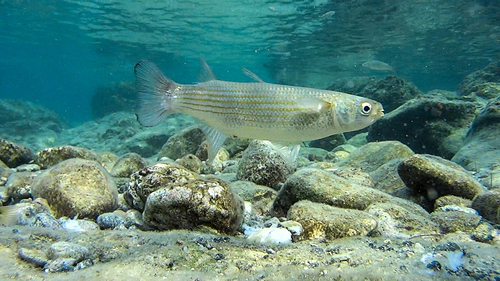
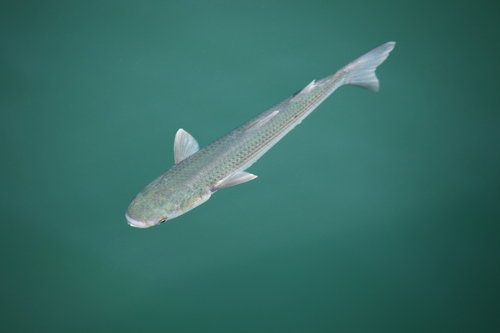
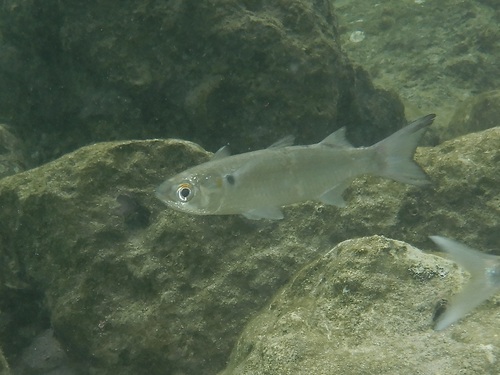
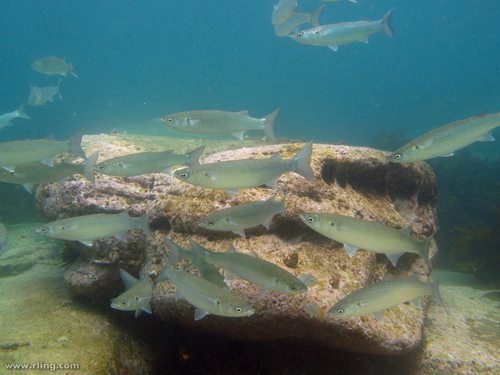
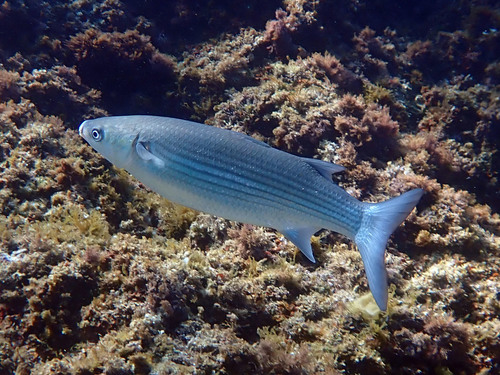
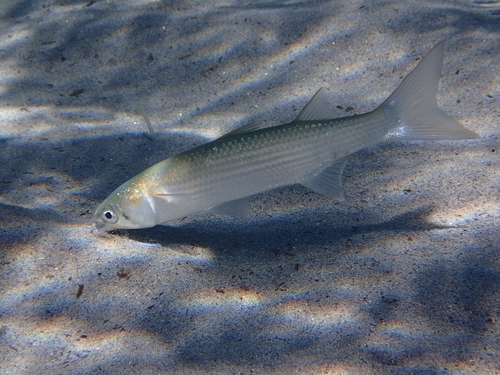
Chelon auratus (Risso, 1810), commonly called the golden grey mullet, has a hydrodynamic, very elegant elongated, roughly cylindrical body with a strong tail fin. Its back is dark grey, transitioning to silver white toward the belly, marked by several grey horizontal stripes. A golden spot is present on each gill cover. This fish reaches a maximum length of around 60 centimetres (24 in) and a maximum weight of around 1.5 kilograms (3 lb 5 oz), but most individuals are much smaller, with an average length of 30 centimetres (12 in). Reproduction occurs in the sea between July and November. Its natural range covers the Eastern Atlantic from Scotland to Cape Verde, including the Mediterranean and Black Sea, and coastal waters from southern Norway and Sweden (it is not found in the Baltic Sea) to Morocco. It is rare off the coast of Mauritania, and has been introduced into the Caspian Sea. The golden grey mullet is a neritic species that typically stays in inshore areas; it enters lagoons, ports, and estuaries, but only rarely moves into freshwater. It feeds on small benthic organisms, detritus, and occasionally insects and plankton. It can be found from shallow waters down to depths of about 20 metres (70 ft), but is most common between 1 and 10 metres (0 to 30 ft). It prefers sandy bottoms covered with various vegetation and small rocks, which provide access to its food and protection from predators such as larger eels, European sea bass, common dentex, and similar predatory species.