About Chelodina longicollis (Shaw, 1794)
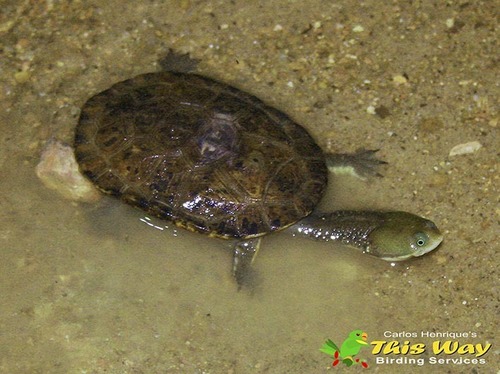
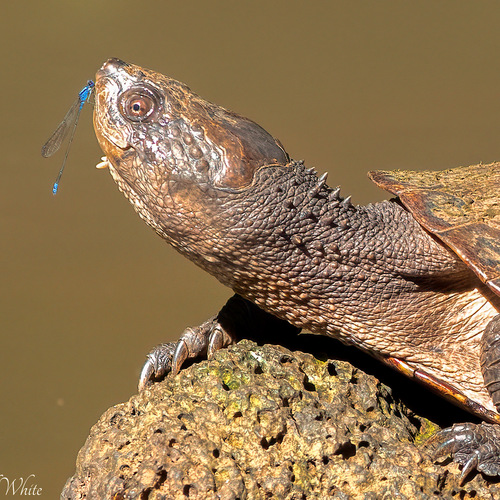
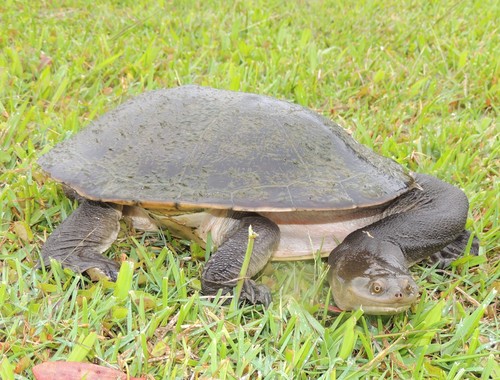
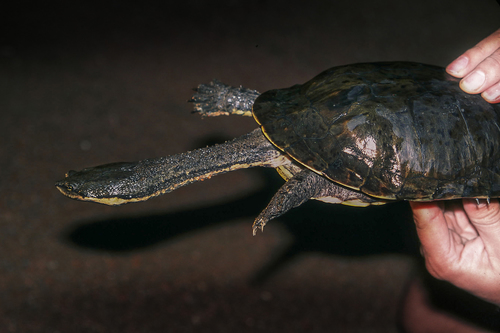
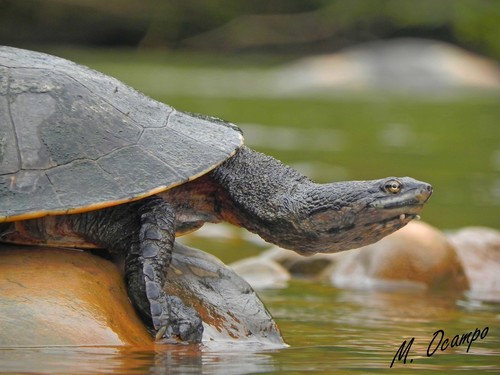
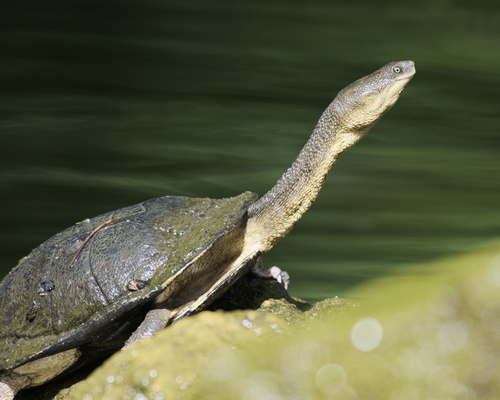
The scientific name of this species is Chelodina longicollis (Shaw, 1794). Its carapace is generally black, though some individuals have brown carapaces. The carapace is broad and flattened, with a deep groove running down its middle. In individuals with a lighter base carapace color, the scutes are edged in black. The plastron is also very broad, and ranges from cream to yellow, with its sutures edged in black. The neck is long and narrow, which is a typical trait for members of the subgenus Chelodina, and reaches approximately 60% of the carapace length. The neck has numerous small pointed tubercles; it is grey to black on the dorsal (upper) side and cream on the underside, a color pattern shared by the turtle's narrow head. Females generally grow to larger sizes and have deeper bodies than males. Recorded maximum sizes for females and males vary across the species' geographic range. In the river environments of the Murray River, maximum straight-line carapace length is 28.2 cm (11.1 in) for females and 24.9 cm (9.8 in) for males. In the Latrobe Valley, this maximum is 21.6 cm (8.5 in) for females and 18.8 cm (7.4 in) for males. This size difference is thought to be linked to the productivity of the local environment. When threatened, this turtle releases an offensive-smelling fluid from its musk glands. This trait gives the species one of its common names, "stinker". Chelodina longicollis is distributed across southeastern Australia. Its range extends east from west of Adelaide in South Australia through Victoria, the Northern Territory, and New South Wales, and north to the Fitzroy River of Queensland. Where Chelodina longicollis occurs alongside Chelodina canni, the two species freely hybridize, and hybrid vigour has been observed in the Styx River Drainage of Queensland. Chelodina longicollis has been introduced to Tasmania, most likely through the pet trade. The species' wide distribution has allowed it to tolerate climates that are much colder than those where most other pleurodire turtles live, including southerly and high-altitude temperate climates. In 2023, a high-altitude individual from the New England Tablelands was found brumating in a pool that had been completely frozen over for 15 days during winter. This marks the first documented case of a pleurodire turtle overwintering under ice. In the species' life cycle, female Chelodina longicollis take 10 years to reach sexual maturity. In early summer, a female will lay between two and ten eggs in the banks of her aquatic habitat. Hatchlings emerge from their eggs three to five months after laying. Young turtles are often preyed on by predators including fish and birds. Females can lay between one and three clutches of eggs each year.