About Chelodina expansa Gray, 1857
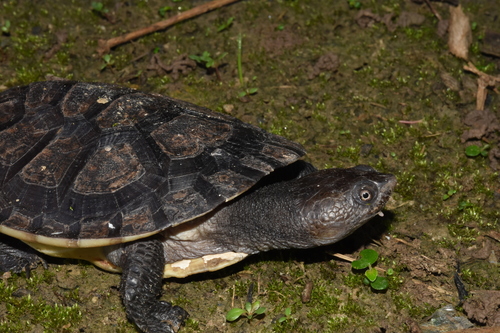
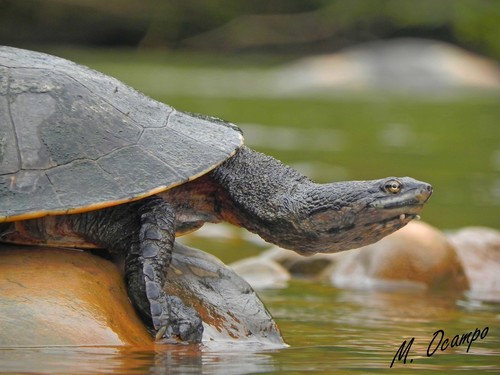
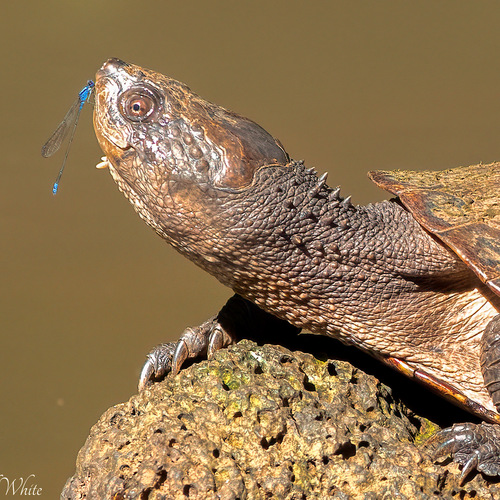
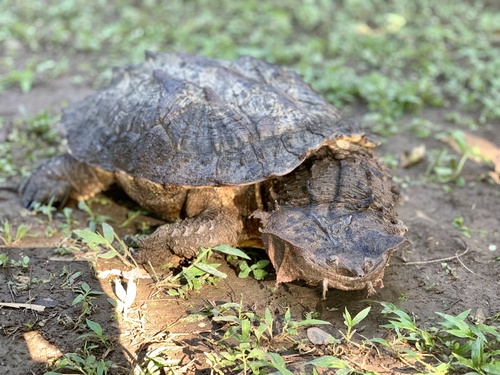
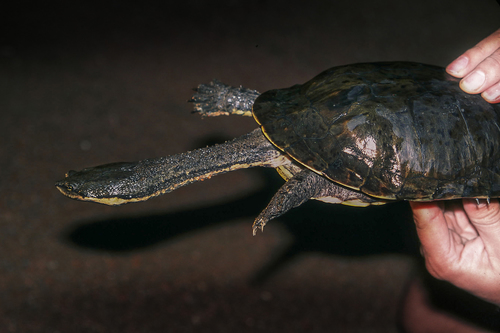
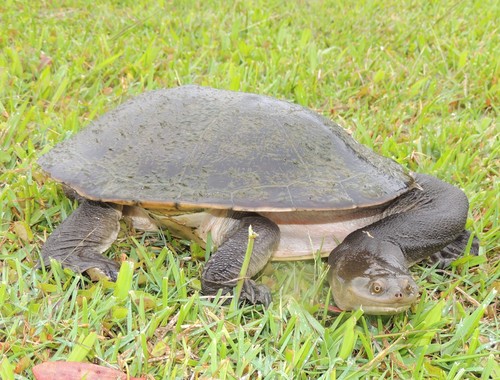
Chelodina expansa Gray, 1857, commonly called the broad-shelled river turtle, is the largest of the long-necked turtles, and has the longest neck relative to body size of any turtle in the world. It has a broad, oval, flattened shell that reaches around 50 centimetres (20 inches) in length, with females typically having a longer carapace than males. The upper carapace ranges from rich brown to blackish-brown, and usually has fine dark flecks or reticulations; the belly is whitish or cream-coloured. The plastron is narrow, and the shell has no noticeable expansion toward the front. The shell is usually twice as long as it is wide, and is broadest at the level of the bridge. The turtle’s head is broad and very flattened, with eyes positioned directly dorsolaterally. When extended, its neck can be longer than the carapace. This species is found throughout the Murray-Darling basin of southeastern Australia, and also has several distinct populations across central and coastal Queensland. It occurs mostly in turbid water deeper than three metres. It is primarily a river turtle that generally lives in permanent streams, but can also be found in oxbows, floodplain ponds, backwaters, and swamps. In South Australia, it is only found in the main channel of the Murray River, and is almost entirely aquatic. It is rarer than the two other freshwater turtle species that live in the Murray River: Emydura macquarii and Chelodina longicollis. Broad-shelled river turtles tend to live in undisturbed environments with moderate vegetation cover, which they use for nest construction. They prefer aquatic habitats with structure, including submerged logs, root systems, and dead trees. Shelter from predators and food availability may influence their habitat preferences, and seasonal changes in water level and flow can also affect the habitats they choose. C. expansa usually nests during Australian autumn or early winter, when soil temperatures drop, though it will sometimes also nest in spring. Although females may travel up to one kilometre from the water’s edge to lay eggs, most nest within 100 metres of the bank. Along the Murray River, nests are often built at the top of sandy ridges. For autumn nesting, nest temperatures first decrease, stay low through winter, then rise slowly through spring to reach their maximum in summer. Females build nests by excavating a nesting chamber with their hind legs to a depth of around 20 centimetres, then deposit between 5 and 28 eggs before backfilling the chamber with soil. They use a distinctive 'body-slamming' behaviour to compact the nest, which forms a hardened plug that helps seal the nest. Nesting can happen at any time of day or night, and is triggered by rain. Turtles choose nest sites with higher sun exposure, and nesting far from the water’s edge is thought to be a behavioural strategy to reduce the risk of nest flooding. Hatchlings face a number of challenges. Incubation is exceptionally long due to naturally slow embryonic development, averaging between 324 and 360 days. Development is also delayed when the embryo goes through two distinct periods of diapause. The first diapause happens inside the female before eggs are laid; this form of diapause is called pre-ovipositional embryonic arrest, and occurs in all turtles. The second diapause is triggered by a drop in nest temperature, and starts after embryonic growth has resumed inside the nest. Young turtles generally hatch in spring. Asynchronous hatching is most likely not adaptive in natural environments. After hatching, young turtles remain in the egg chamber until heavy rain triggers their emergence. Rain softens the nest soil, which becomes compact and hard during the long incubation, allowing the hatchlings to dig their way out through the softened soil.