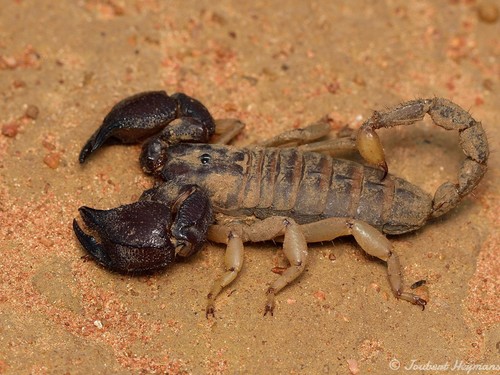
About Cheloctonus jonesii Pocock, 1892
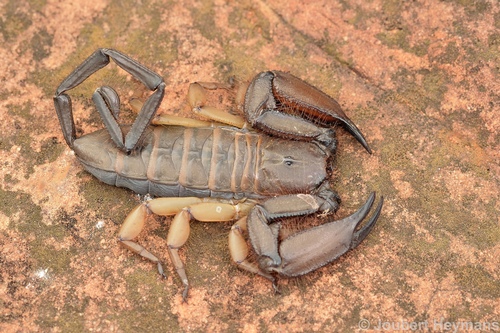
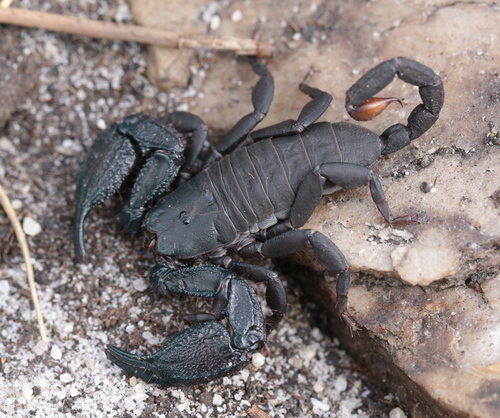
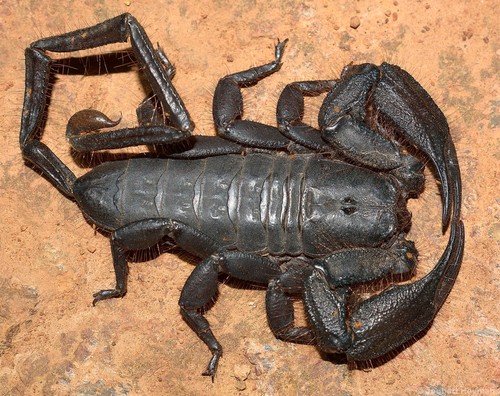
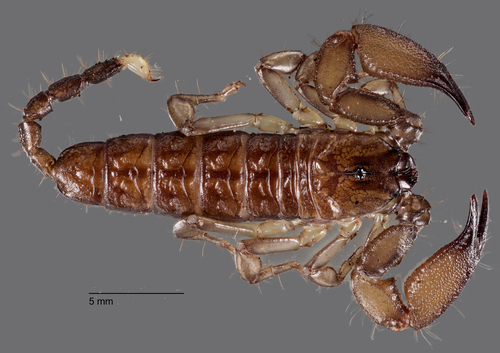
This species of scorpion, Cheloctonus jonesii, can grow up to 9 cm (3.5 in) in total length. Its appearance varies across its range: specimens from northern KwaZulu-Natal are entirely black, while those from Mpumalanga are brown with yellow legs, and legs are otherwise rust-colored. It has a heavy-set body with stocky legs, stout pedipalps (arms), and short chelae (pincers). Its cephalothorax measures approximately 11 mm in length and 11.5 mm in width, and its tail reaches around 3.5 cm (1.4 in) long. British naturalist R. I. Pocock first described this scorpion in 1892, and named it in honor of C.R. Jones, who collected the type specimen in the Murchison Range of what was then Transvaal. Cheloctonus jonesii is native to Zimbabwe, Mozambique, Eswatini, and eastern South Africa, and is particularly common in KwaZulu-Natal. In KwaZulu-Natal, it reaches population densities of two burrows per three square meters, and densities of four burrows per square meter have been recorded in Jozini. It inhabits areas with clay-based soil and annual rainfall between 800 and 1250 mm (30 to 50 in), and avoids waterlogged areas. The species excavates vertical burrows that are around 18 cm (7 in) deep, typically placed at the base of one or more grass tufts. It takes the scorpion 2 to 3 nights to finish digging the burrow: it uses its pincers to loosen soil, then uses its pedipalps and pincers like spades to carry soil away from the burrow. It feeds on dung beetles that fall into its burrow, and has also been recorded killing red-billed quelea. Predators of Cheloctonus jonesii include large centipedes of the genus Scolopendra, ground-foraging red-billed hornbills (Tockus erythrorhynchus) and eastern yellow-billed hornbills (T. flavirostris), bushveld gerbils (Gerbilliscus leucogaster), Cape porcupines (Hystrix africaeaustralis), and lesser red musk shrews (Crocidura hirta).