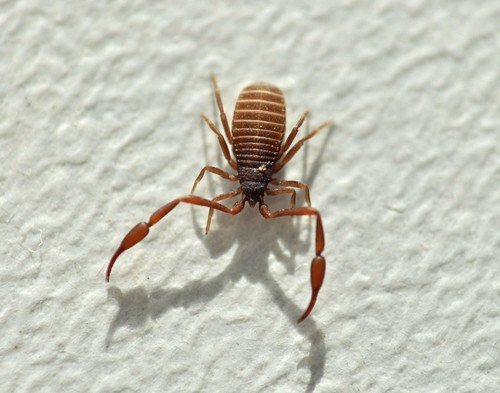
About Chelifer cancroides (Linnaeus, 1758)
Chelifer cancroides individuals measure 2.5–4.5 mm (0.098–0.177 in) in body length. When fully extended, their very long pedipalps reach 7–9 mm (0.28–0.35 in) in length. The species has a teardrop-shaped body colored a rich mahogany. Its abdomen contains 12 segments, of which only 10 are easily visible. The cephalothorax bears one pair of eyes. This species can be separated from other members of the family Cheliferidae by several diagnostic features. The carapace has large, setose tubercles. In males, the carapace and tergites I-VII or I-VIII have distinct lateral keels. The cheliceral hand has 4 setae, and lacks seta sbs. Adult tarsal claws have a lateroventral process, with the exception of the claws on the first leg pair of adult males. The subterminal tarsal setae are denticulate. In males, coxa IV is strongly arcuate, has a large lateral process, and contains a coxal sac that does not have a differentiated atrium. Male genitalia include rams horn organs, and an anteriorly invaginated lateral rod that forms a median depression, where a sclerotic rod is located. Female genitalia have paired spermathecae and paired median cribriform plates. Chelifer cancroides has been recorded in North America, Europe, Africa, and Australia. It has been found under tree bark, in caves, in bird nests, and in bee hives. It also phoretically rides on bats, flies, and hymenopterans, and occurs in human-built structures including houses, stables, barns, chicken coops, and bee hives. For reproduction, males maintain small mating territories just a few centimeters in size. When a female enters the territory, the male begins a mating dance and eventually deposits a spermatophore, which is then picked up by the female. Fecundity ranges from 20 to 40 eggs. Development from egg to sexual maturity takes 10–24 months and requires three molts; molting may involve the construction of a silk nest. Individuals usually live three to four years.

