About Chelidoptera tenebrosa (Pallas, 1782)
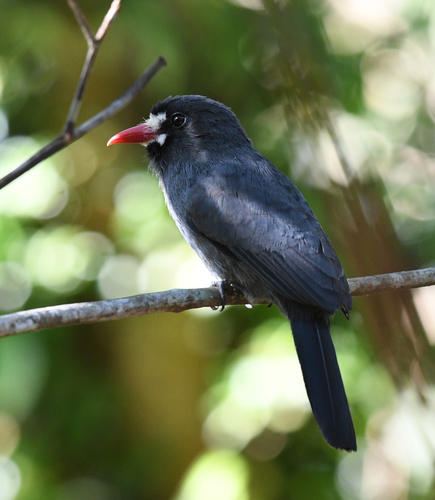
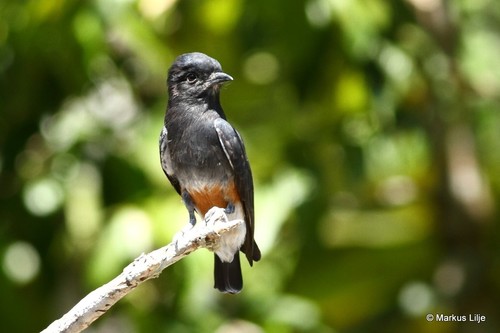
The swallow-winged puffbird (Chelidoptera tenebrosa, originally described by Pallas in 1782) measures 14 to 15 cm (5.5 to 5.9 in) in length and weighs 30 to 41.5 g (1.1 to 1.5 oz). The nominate subspecies has sooty black upperparts with faint bluish iridescence, a white lower back and rump, a short black tail with white feather tips that wear away quickly, and long, pointed wings. Its chin is whitish, throat grayish, and breast sooty black, fading to gray on its lower portion. The belly is orange-chestnut, the bill is black, the eye is dark brown, and the feet are dark gray or black. Subspecies C. t. brasiliensis is larger than the nominate. It has a whitish band that separates the gray lower breast from the belly, which is more ochraceous than the nominate's belly. Subspecies C. t. pallida has paler underparts than the nominate, with a distinct white band separating the gray lower breast from the chestnut belly.
This species is found across the entire Amazon Basin, reaching the Andean foothills to the west and extending south through central Brazil, with an additional separate population along the southeastern Brazilian coast. The nominate subspecies is the most widespread by far, occurring across most of Venezuela, south through eastern Colombia, Ecuador, and Peru to northern Bolivia, and east through the Guianas and much of interior Brazil to Brazil's northwestern coast. C. t. brasiliensis occurs in the Atlantic Forest of southeastern Brazil, from roughly Rio Grande do Norte south to Espírito Santo. C. t. pallida is found only in Zulia, Venezuela's far northwestern state. The swallow-winged puffbird lives in a range of open and semi-open landscapes. It appears to prefer open areas with scattered bushes growing on sandy soil within generally forested regions. It has also been recorded in savanna, the edges of transitional, secondary, and deciduous forest, várzea forest, and gallery forest. In terms of elevation, it mostly occurs between sea level and 1,000 m (3,300 ft), but can be found locally as high as 1,750 m (5,700 ft).