About Chelidonium majus var. asiaticum (H.Hara) Ohwi
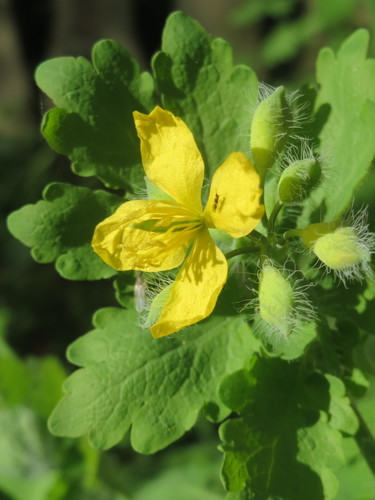
This is a description of Chelidonium majus var. asiaticum (H.Hara) Ohwi, a variety of greater celandine. Greater celandine is an erect perennial herbaceous plant that grows 30 to 120 cm (12 to 47 inches) tall. It produces blue-green pinnate leaves that can reach up to 30 cm (12 inches) long, with lobed, wavy margins. When injured, the plant oozes a yellow to orange latex. Its flowers each have four yellow petals around 18 mm (0.71 inches) long and two sepals. A naturally occurring double-flowered variety of this species exists. Flowers bloom from late spring to summer, which falls between May and September in the UK, and are arranged in umbelliform cymes that hold around four flowers each. The plant's small, black seeds are held inside a long, cylindrical capsule. Every seed has an elaiosome, a structure that attracts ants, which then disperse the seeds through a process called myrmecochory. Chelidonium majus, the parent species of this variety, is native to most regions of Europe. It also occurs in North Africa in Macaronesia, Algeria, and Morocco, and in Western Asia, where it grows in the Caucasus, Armenia, Azerbaijan, Georgia, Kazakhstan, Mongolia, Siberia, Iran, and Turkey. It grows in habitats including rocky slopes, woodlands, waste areas, and roadsides. In parts of North America, greater celandine is classified as an aggressive invasive plant, and it is considered invasive in other regions outside its native range as well. For example, it is listed as a restricted plant in the U.S. state of Wisconsin. It is most commonly controlled by pulling or spraying the plants before seed dispersal occurs.