About Chelidonichthys lucerna (Linnaeus, 1758)
Chelidonichthys lucerna, commonly known as the tub gurnard, is the largest species in the Triglidae family. This species reaches a maximum total length of 75.1 cm (29.6 in), though a total length of 30 cm (12 in) is more typical. The heaviest published specimen on record weighed 6 kg (13 lb).
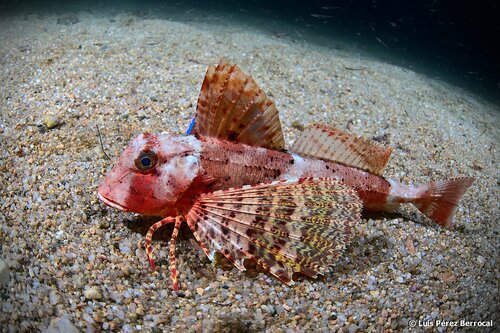
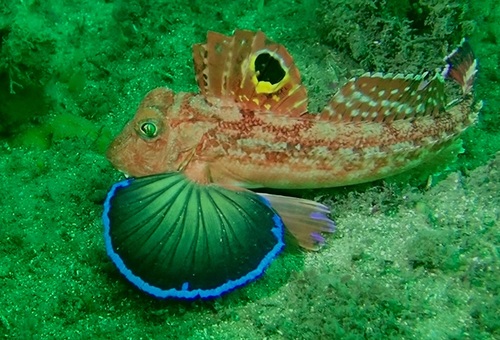
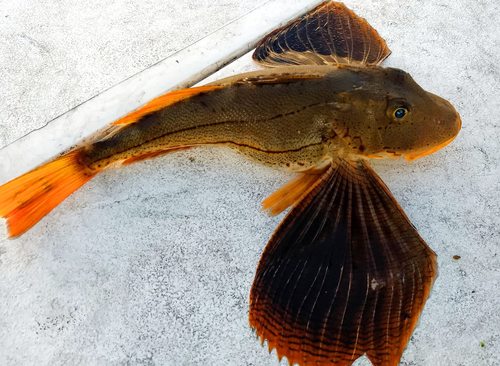
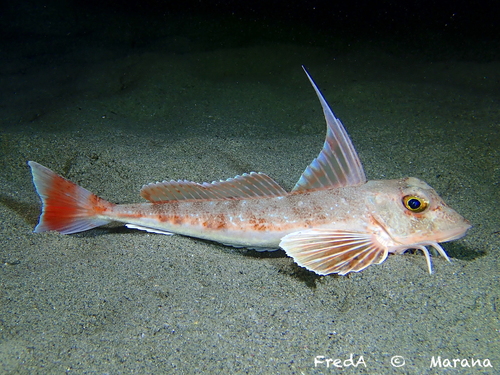
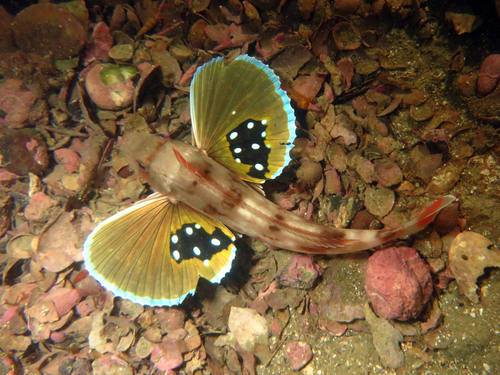
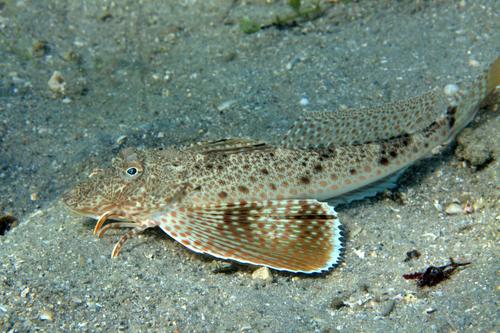
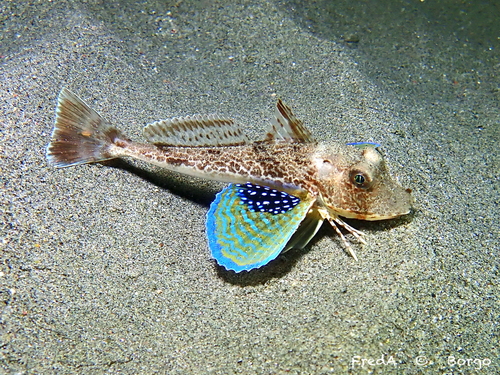
Its overall body colour is deep reddish brown to pinkish red, with a pinkish lower body. The pectoral fins are blue, with green spots in their centres and red colouring along their margins. The tub gurnard has a large, bony, triangular head marked by many ridges and spines, and it lacks an occipital groove. There are two spiny lobes at the tip of the snout, and the eyes are relatively small. Its large mouth is positioned low on the head, and the jaws and vomer are covered by densely packed rows of teeth.
There are two dorsal fins: the first holds 8 to 10 spines, and the second holds 16 or 17 soft rays. The anal fin has between 14 and 16 soft rays. The cleithral spine is short, located over the pectoral fin and extending only to the first quarter of the fin. The lower three rays of the pectoral fins have developed into separate, finger-like processes packed with sensory organs; the gurnard uses these to "walk" and detect prey within sediment. These tentacle-like sensory appendages are adapted pelvic fins located under the head.
The breast and front section of the belly have no scales. The rest of the body has small, deeply embedded scales, while the scales along the lateral line are small and tubular. The caudal fin is slightly emarginate.
The tub gurnard is found in the Eastern Atlantic Ocean, ranging from Norway south along European and African coasts as far south as Ghana. It occurs throughout the Mediterranean Sea, Black Sea, and Sea of Marmara, and in coastal waters around the British Isles and the Canary Islands, but is absent from Madeira and the Azores. Its distribution is currently shifting northwards, and it has become increasingly abundant in the Central North Sea.
This species lives on sand, mud-sand, or gravel substrates at depths between 20 and 300 m (66 and 984 ft), and can also be found in the lower sediment layers at the bottoms of lakes, oceans, and streams. It makes annual migratory movements within its depth range, moving to shallow waters in spring and summer and returning to deeper waters in winter. During summer, it may spend more time near the surface in water as shallow as 10 m (33 ft). Experiments have confirmed that the tub gurnard migrates between habitats of different salinities throughout its life cycle, which demonstrates its high adaptive capacity and explains its large, widespread distribution. Juvenile tub gurnards live in brackish water in lagoons, estuaries, and even the lower reaches of rivers, and are concentrated in shallow waters where food is abundant. Spatial separation between adults and juveniles is observed in this species, with the distance between groups being very pronounced: adults are more dispersed in offshore sites.
The parasitic roundworm Hysterothylacium aduncum, for which benthic fish act as typical second intermediate hosts, has been found in the stomachs of tub gurnards from the south-eastern Baltic.
Spawning occurs between May and July in the northern parts of the tub gurnard's range, while off Egypt it takes place from November to February. On the Georgian coasts of the Black Sea, spawning occurs from May to September, and females produce between 100,000 and 300,000 pelagic eggs. Pelagic eggs allow females to release their young in open areas close to shore. The eggs are round, smooth, and non-sticky. This species is dioecious, meaning each individual has either male or female reproductive organs, and fertilization is external. Males and females form distinct pairs to spawn. The eggs are pelagic, and in larvae and post-larvae, all pectoral fin rays are contained within the fin membrane. Tub gurnards begin reaching sexual maturity at a total length of 13 cm (5.1 in), and all fish larger than 20 cm (7.9 in) are sexually mature.