About Chelidonichthys kumu (Cuvier, 1829)
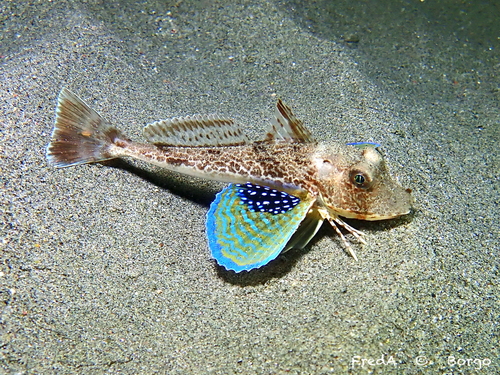
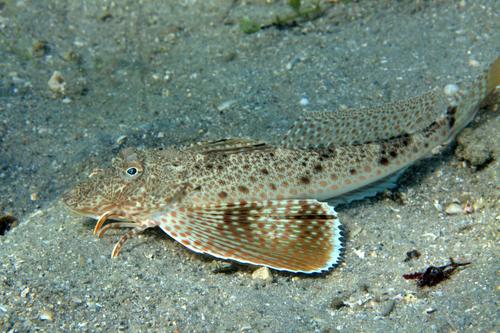
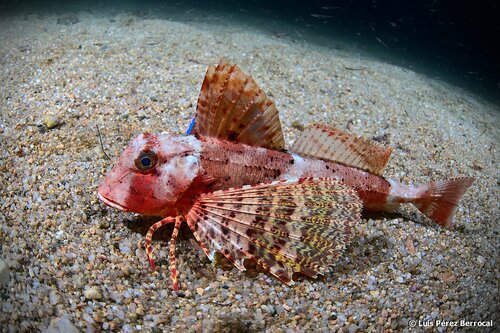
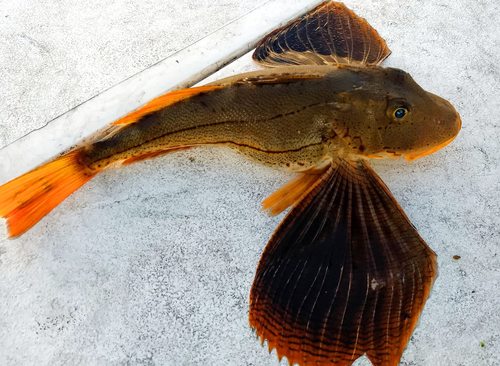
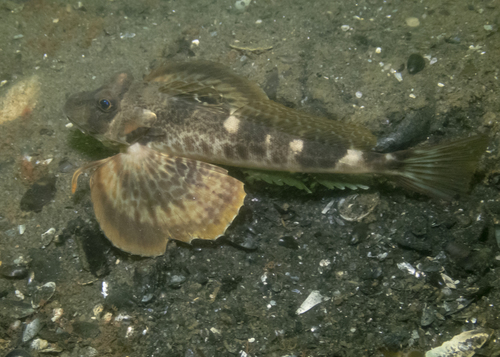
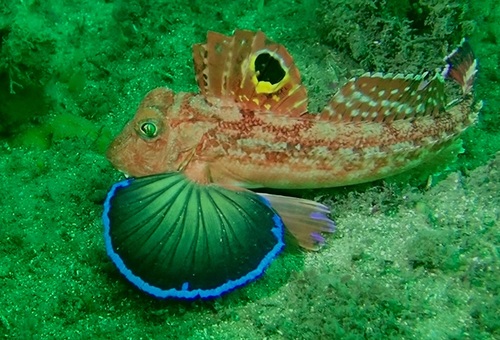
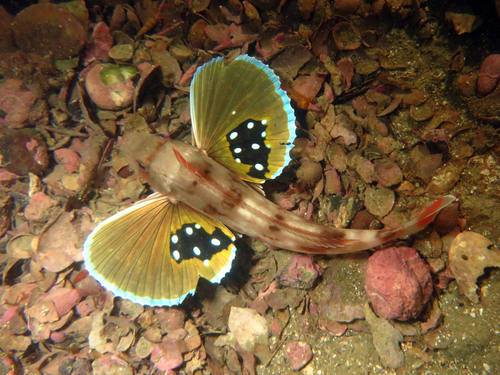
The bluefin gurnard, Chelidonichthys kumu, is a bottom-dwelling fish. It is most recognizable for its bright red body and large colourful pectoral fins, which have a large black eye-spot at the center surrounded by a bright blue edge. Its natural base colour is splotchy pale brown; it generally only turns red when stressed, and its belly is paler, sometimes even white. It has a boxy, bony head that is protected by backwards-facing spines: these spines run along the front of the snout, around the eye, and on the hind margin of the operculum. The body tapers from the head into a laterally elongated shape, and has 33 to 35 vertebrae. This species has 8 to 10 gill rakers, and 70 to 80 scales along its uninterrupted lateral line. It has two tall triangular dorsal fins, which hold a total of 9 to 10 spines and 15 to 16 soft rays, and it does not have an adipose fin. The anal fin has 14 to 16 soft rays and no spines. The large fan-like pectoral fins are one of two pairs of pectoral fins, and have 13 to 14 soft rays. The pelvic fin has 5 soft rays and a single spine. The first three rays of the pectoral fin are modified and separated from the rest of the fin. These modified rays act as sensory organs, sometimes called "fingers", which the fish uses to probe the seabed to find prey buried in sand or mud. The striking appearance of these fins has earned the bluefin gurnard the nickname "butterfly of the sea", but the full function of the spectacular fins is not fully confirmed; they may be used to attract mates or scare off predators, and they also provide stability while swimming. Bluefin gurnard are widespread across central tropical and temperate Indo-West Pacific waters. They are common off the coasts of New Zealand, Australia, South Africa, and many South Pacific islands. It remains unconfirmed whether historical records of this species from Japan, Korea, China, and the Hawaiian Islands are correct, or if they represent misidentifications. In New Zealand, the bluefin gurnard is the most common gurnard species. It occurs in all coastal waters around the North and South Islands, with the exception of the southern fiords. It is also found around Stewart Island, the Chatham Islands, and the Kermadec Islands. Large population hotspots are located around the Bay of Plenty, Hawke Bay, Banks Peninsula, Foveaux Strait, the west coast of the North Island, and the north and northwest coasts of the South Island. As a benthic marine fish, the bluefin gurnard prefers shallow coastal waters with soft sand, sandy-shell, or mud bottoms. It can be found from the edge of continental shelves into estuaries and brackish rivers. The species walks slowly over the seabed using its three free modified pectoral fin rays, and can bury itself in the substrate, leaving only the top of its head, nostrils, and eyes exposed to ambush prey. It has been recorded in water as shallow as 1 meter, most commonly lives at depths between 100 and 200 meters, and can reach maximum depths of up to 300 meters.