About Cheiroglossa palmata (L.) C.Presl
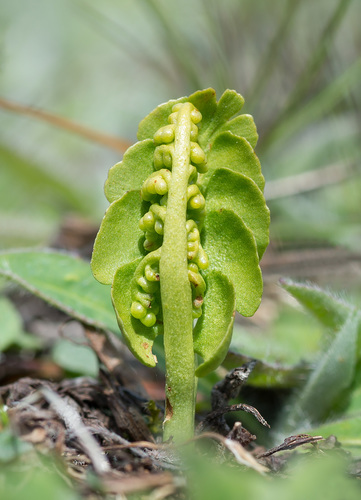
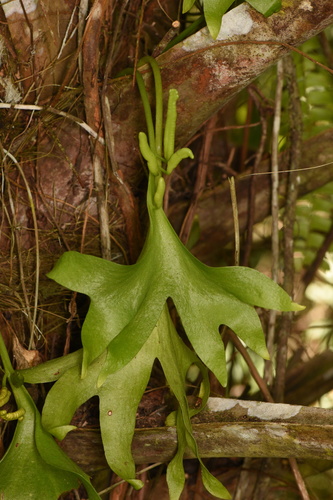
Cheiroglossa palmata has palmately lobed leaves roughly shaped like a hand, reaching up to 30 cm wide, with entire margins that lack serration. Fertile fronds are made up of a set of small, tapering sporophores that bear spores. Several to many of these sporophores grow at the base of each leaf blade. Sporangial clusters sit on the sporophores, with sporangia arranged in two rows, all embedded in compact, linear spikes. The main areoles are large, usually measuring more than 30 mm across. Its pale yellowish-brown roots are dichotomous. The gametophytes of Cheiroglossa palmata are brown to white, cylindric, and repeatedly branched. This species occurs naturally in the Neotropics; within the United States, it is restricted to the far southeastern region, primarily Florida. It has become rare in Florida, a result of overcollection and extensive drainage of natural wetlands caused by development and water diversion projects. It has been reported that this species does not survive cultivation.