About Cheiracanthium inclusum (Hentz, 1847)
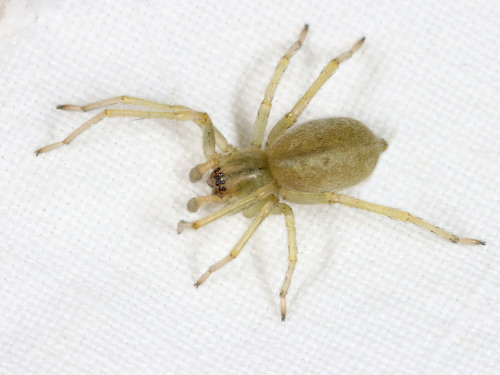
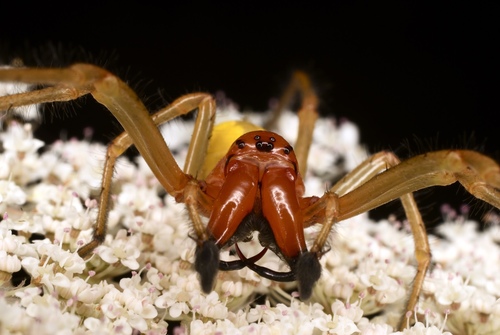
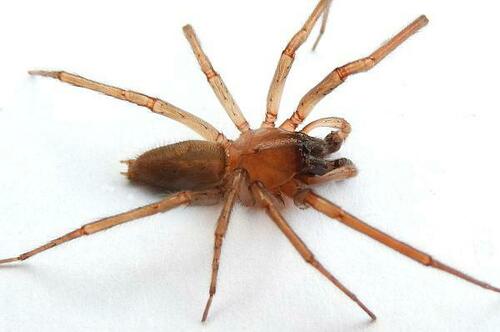
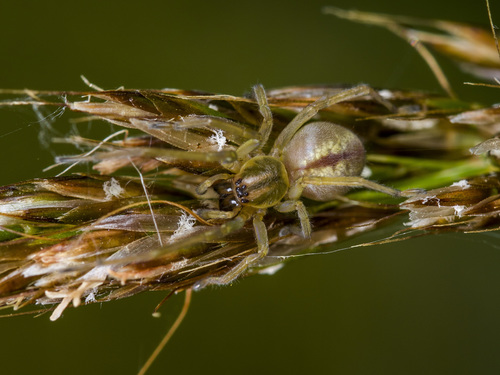
Identification. Like all spiders, Cheiracanthium inclusum has two body segments: a cephalothorax (fused head and thorax) and an abdomen. Females have a body length between 5 and 9 mm, while males have a body length between 4 and 8 mm. The spider’s leg span can reach up to 1 inch (2.5 cm), and its front pair of legs is longer than the other three pairs. Males typically have narrower bodies and larger leg spans than females. C. inclusum gets its two common names (yellow sac spider and black-footed spider) from its appearance. Its body is pale yellow-beige, with dark brown markings on its palps, chelicerae (jaws), and the ends of its tarsi (feet). An orange-brown stripe often runs down the top center of its abdomen. C. inclusum has eight eyes of similar size, arranged in two parallel horizontal rows. Because the spider is active at night when there is little light, visual input is of minor importance to it. It relies more on its palps—sensory structures located just behind the chelicerae on the prosoma (cephalothorax)—to sense its surrounding environment. Distribution. C. inclusum is native to the New World, which includes North America, Central America, South America, and the West Indies. This species has also been introduced to Africa and Réunion. It is most commonly found in trees and shrubs, but may also take shelter in houses and other human-made structures. Life cycle. Female C. inclusum mate only once, and produce their first egg mass approximately 14 days after mating. They usually produce two sets of eggs, though the total number can range from 1 to 5. Egg masses typically hold between 17 and 85 eggs, though one egg mass has been reported to hold as many as 112 eggs. Egg laying usually takes place in June and July. During this period, females lay their eggs inside small 2 cm silk tubes, and enclose themselves with the eggs to protect them from predators. Females stay with the eggs and newly hatched juvenile spiders for about 17 days, until the juveniles complete their first molt. Females that produce additional egg masses build a second egg sac around two weeks after the juvenile spiders from the first brood disperse. Males typically reach sexual maturity earlier than females, with an average of 119 days for males compared to 134 days for females. The time to maturity can range from 65 to 273 days, depending on multiple factors including temperature, humidity, and photoperiod. C. inclusum normally overwinters in the adult or sub-adult stage.