About Cheilotrema saturnum (Girard, 1858)
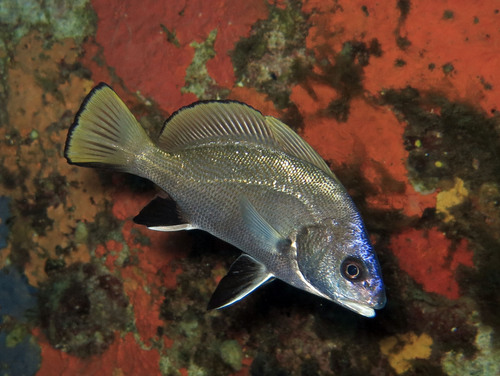
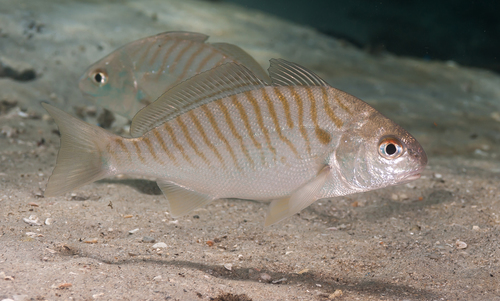
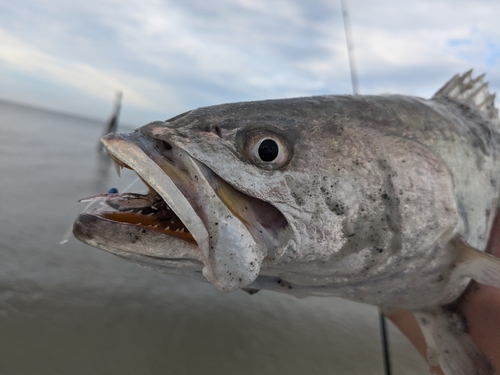
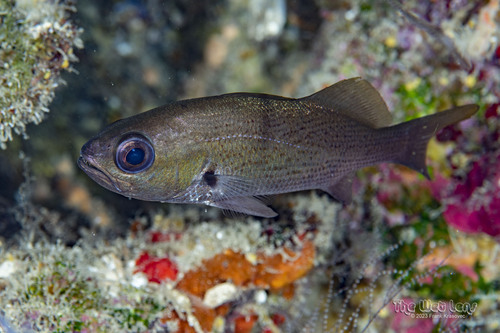
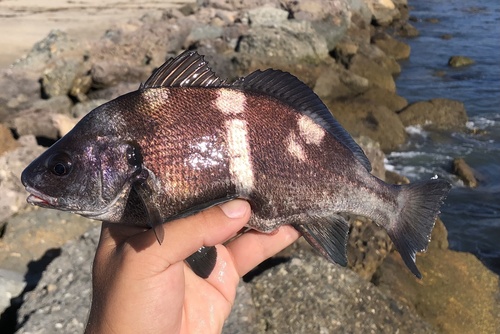
Scientific name: Cheilotrema saturnum (Girard, 1858). Black croakers have compressiform bodies, an inferior mouth, and a truncate tail. Adult fish are mostly black with a silver ventral side, often having 3 - 5 blotches on the dorsal surface and a vertical white stripe below the margin between the two dorsal fins. Additional vertical stripes or blotches on the sides may also be seen. Adult fins range from clear to black. Juveniles are slightly more fusiform than adults, silver - colored with 3 - 6 horizontal black stripes along their body. The maximum recorded standard length is 381mm, but adults usually reach 300mm. The length - weight relationship is given by the equation W = 0.00004L^2.9223, where W is weight in grams and L is standard length in millimeters. These fish can live up to 21 years, which is long for croakers, and there is no sexual dimorphism in growth. They are distributed from the northern Southern California Bight to the southern Baja California Peninsula and the northern Sea of Cortez. In the Southern California Bight, they are abundant in mainland nearshore habitats and less common at Catalina Island. Populations are concentrated near rocky headlands like Palos Verdes. Black croakers are found at depths from the surface to about 45m, most frequently at 3 - 15m. They prefer rocky habitats, occurring more often in rocky reefs than kelp forests. In summer, adults may be seen over sand patches. Habitat choice can change with water conditions; they are more likely in caves and underwater structures during low - turbidity periods and may be 3 meters off the sea floor when visibility is low. Their primary diet consists of crustaceans, such as shrimp and crabs. The spawning season is typically from late spring to summer, peaking in midsummer. Females release mature eggs continuously during the spawning season, and recruitment is relatively lower during cold water years.