About Cheilodactylus spectabilis Hutton, 1872
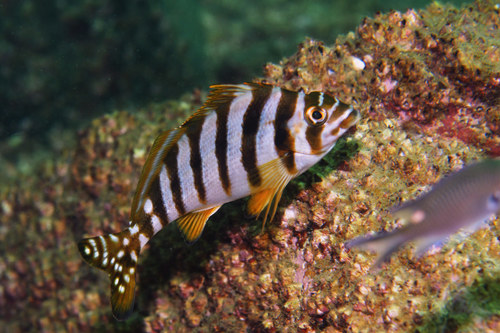
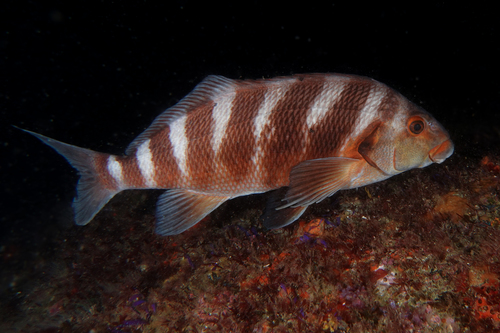
Cheilodactylus spectabilis, commonly called red moki (or banded morwong in Australia), is a distinctively marked fish. Its body is overall silvery to light brown, with white colouring on the underside of the head and body. It has 7 to 8 widely, uniformly spaced bands that range from rufous to nearly black along its flanks; the first 3 or 4 of these bands angle toward the head, while the remaining bands are vertical. The fins of the red moki have blackish margins and reddish bases. Rare individual red moki are plain reddish brown, with no bands or only indistinct bands. This species has thick, fleshy lips, and its lower pectoral fin rays are relatively short compared to other morwongs. The maximum recorded total length for the species is 100 cm (39 in). Red moki is restricted to the southwestern Pacific Ocean, found in Australia and New Zealand. In Australia, where it is more often called banded morwong, it occurs from Seal Rocks, New South Wales, to Kangaroo Island in South Australia, and is also found around Tasmania and the islands of the Bass Strait. It may occur as far west in South Australia as Point Drummond on the western coast of the Eyre Peninsula. In New Zealand, it is found from the Three Kings Islands to Foveaux Strait. This species reaches its maximum abundance around Tasmania and off the northern part of New Zealand's North Island. Red moki lives around coastal reefs in shallow waters, especially in areas exposed to wave surges, such as reefs off exposed rocky headlands. It is common in areas with kelp and other seaweeds, and close to caves, crevices and overhangs. Adult red moki inhabit deeper waters than juveniles, and the species can be found at depths between 1 and 50 m (3 ft 3 in and 164 ft 1 in).