About Cheilodactylus fasciatus Lacepède, 1803
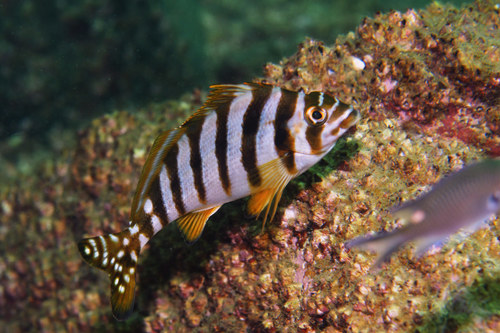
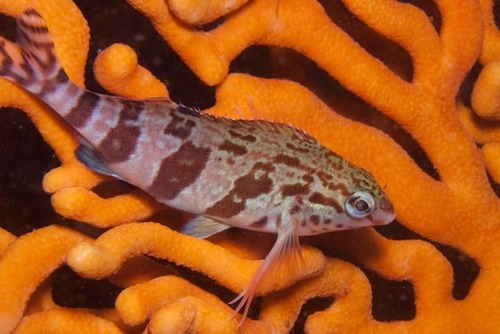
The redfingers (Cheilodactylus fasciatus Lacepède, 1803) has an oval-shaped body, where its body depth is 3.2 to 3.7 times its standard length. It has a small mouth, a pointed snout, and a slightly concave breast. The dorsal fin has 17 to 19 spines and 23 to 25 soft rays, while the anal fin contains 3 spines and 9 to 11 soft rays. This species reaches a maximum total length of 30 cm (12 in). The pectoral fins have 14 rays, with the lower 4 to 5 rays enlarged and red in colour. There are four wide reddish-brown stripes on the lower flanks, and five quadrangular marks on the upper flanks that align with the stripes on the rear of the body. The head is covered with rectangular spots and dashes, and the caudal fin has diagonal brown stripes. Redfingers is endemic to the waters of southern Africa, found in both the southeastern Atlantic Ocean and the southwestern Indian Ocean. Its range extends from Swakopmund in Namibia to northern KwaZulu-Natal in South Africa. They are typically found at depths down to 25 m (82 ft), although they are occasionally recorded as deep as 120 m (390 ft). This species occurs in rocky areas, especially reefs, while juveniles are commonly found in tidal pools.