About Cheilinus undulatus Rüppell, 1835
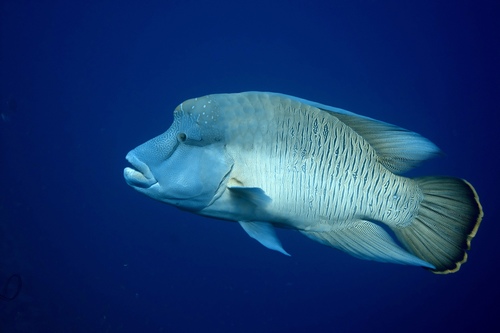
Cheilinus undulatus, commonly known as the humphead wrasse, is the largest living member of the wrasse family Labridae. Males are typically larger than females, capable of growing up to 2 meters long and weighing up to 180 kg, while the species' average length is just under 1 meter. Females rarely reach sizes larger than one meter. This species is easily identifiable by its large body size, thick lips, two black lines located behind its eyes, and a characteristic hump on the forehead of larger adult individuals. Its body color ranges from a dull blue-green to brighter shades of green and purplish-blue. Adult humphead wrasses are most often found living alone, though they may also be seen in male-female pairs or small groups. Humphead wrasses occur along the east coast of Africa near the mouth of the Red Sea, as well as in parts of the Indian and Pacific Oceans. Juvenile humphead wrasses typically inhabit shallow, sandy areas that border coral reef waters, while adults mostly occupy offshore, deeper sections of coral reefs. Adults are most commonly found on outer-reef slopes and channels, though they also live in lagoons, generally at depths between 0.91 and 100.58 meters (3 to 330 ft). During the settlement stage, the species actively chooses branching hard corals, branching soft corals, and seagrasses. Juveniles tend to live a more hidden lifestyle in areas with dense branching corals, bushy macroalgae, or seagrasses. Larger individuals and adults occupy restricted home ranges in more open habitats along reef edges, channels, and reef passes. The humphead wrasse is a long-lived species with a very slow reproductive rate. Individuals reach sexual maturity between 5 and 7 years of age, and have a typical lifespan of around 30 years. Humphead wrasses are protogynous hermaphrodites, and some individuals change sex to become male at around 9 years old. The factors that control the timing of this sex change remain unknown. At specific times of year, adult humphead wrasses move to the down-current end of reefs to form local spawning aggregations, and they likely do not travel long distances to reach these spawning groups. Their pelagic eggs and larvae eventually settle on or near coral reef habitats. The species' eggs are spherical, 0.65 mm in diameter, and have no pigment. Humphead wrasses are highly opportunistic predators. They primarily prey on invertebrates including mollusks, specifically gastropods, plus pelecypods, echinoids, crustaceans, and annelids, as well as other fish. They even prey on the highly venomous crown-of-thorns starfish. Since half of all echinoids and most pelecypods hide beneath sand, humphead wrasses may either rely on sediment-excavating fish such as stingrays to uncover prey, or excavate sand themselves by ejecting water to displace sand and rooting through sediment with their snouts. Like many other wrasses native to the Red Sea, humphead wrasses often crack open sea urchins (echinoids) by holding the urchins in their mouths, carrying them to a rock, and striking the urchins against the rock with quick sideways movements of the head. The species sometimes takes part in cooperative hunting with the roving coral grouper.