About Cheilinus lunulatus (Forsskål, 1775)
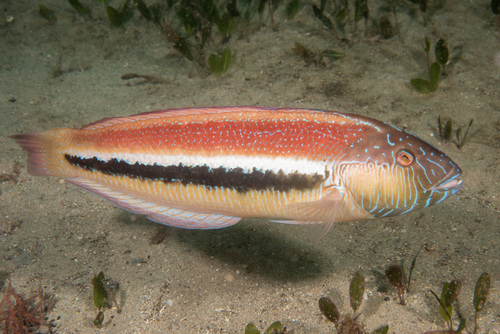
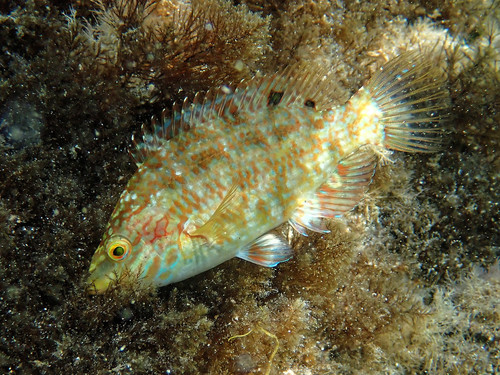
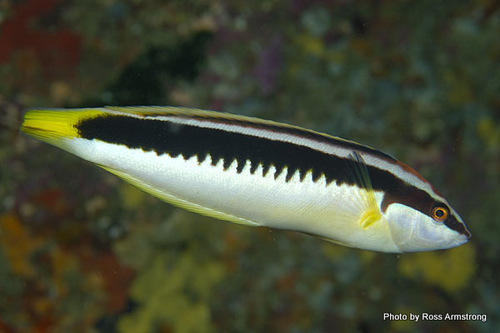
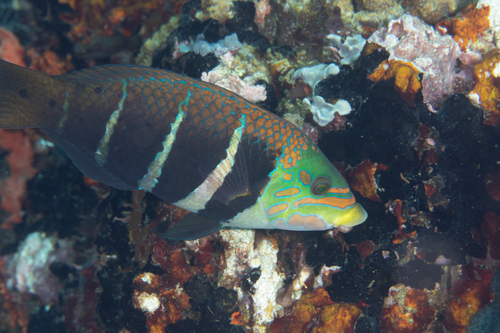
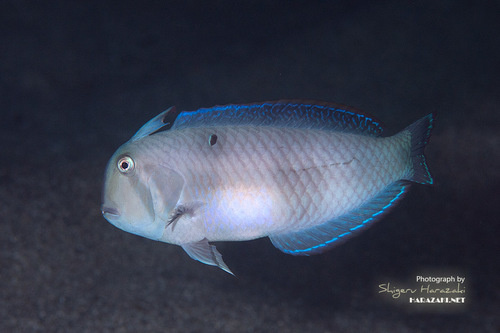
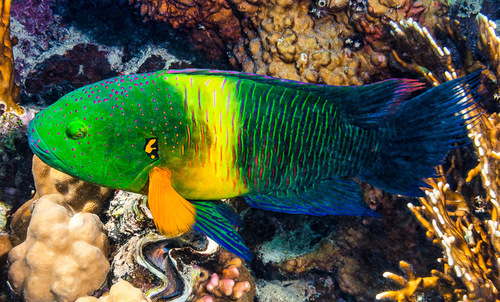
Cheilinus lunulatus, commonly called the broomtail wrasse, reaches an average body length of about 35 cm (14 in), with males growing to a maximum length of 50 cm (20 in). Adult individuals have a large bright green head covered in small spots, and large blue lips. Their pectoral fins are yellow, while their abdominal, anal, and caudal fins are dark blue. The middle section of the body is yellow-green, and the rest of the body is dark purple. A characteristic bright yellow marking on a black background is located near the operculum. This species has a long fringed caudal fin that resembles an old broom, which gives the fish its common name, or the tail of a crowntail betta. Females and juveniles display large dark stripes along their flanks. This wrasse feeds mainly on molluscs and other hard-shelled invertebrates, and it is an oviparous species. This species' distribution ranges from the Red Sea to the Gulf of Oman, and it occurs mainly near Djibouti, Eritrea, the Seychelles, and Somalia. In the Indo-Pacific region, this species is replaced by its close relative Cheilinus trilobatus. Broomtail wrasses inhabit coral reefs and adjacent sand and seagrass habitats, at depths between 2 and 30 m (6.6 to 98.4 ft).