About Chasmanthium latifolium (Michx.) H.O.Yates
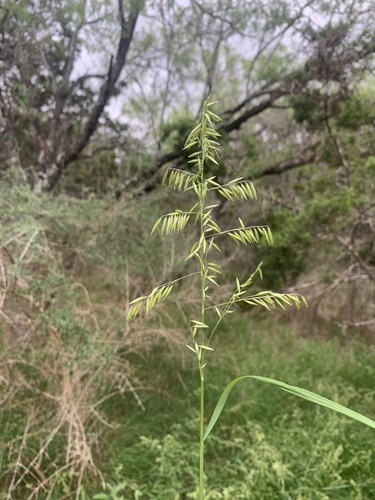
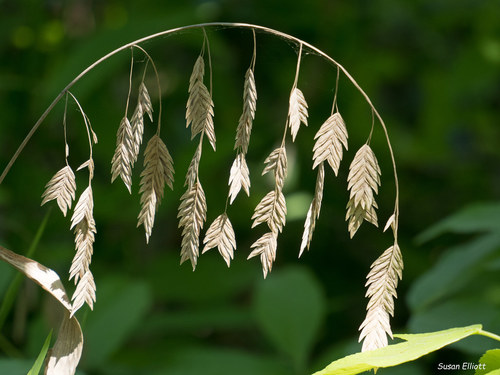
Chasmanthium latifolium (Michx.) H.O.Yates is a cool-season, rhizomatous perennial grass. Its culms grow to roughly 1 meter (3.3 ft) in height, and it produces an open, nodding panicle inflorescence made of laterally flattened spikelets. This species typically grows in wooded areas and riparian zones. It is native to the lower 48 United States. Across the arid west, Atlantic coast, Gulf Coastal Plain, Western mountains, valleys, and coast, it is found equally often in both wetland and non-wetland areas. In the Eastern Piedmont mountains and Great Plains, it usually grows in non-wetlands. In the Midwest, Northcentral, and Northeast regions, it usually grows in wetlands. In Mississippi, it is a common species in the river bank community that occurs between the edge of the water and the high water mark, where the substrate is frequently disturbed and composed of sand, acidic soils, and rocky outcrops. Like most species in the Poaceae grass family, Chasmanthium latifolium is wind-pollinated. A limited pollination range has significantly reduced gene transfer along the edges of its range, which lowers genetic diversity. Low genetic diversity and limited gene transfer between edge populations make this species more susceptible to climate change and disease. Its optimal growing temperature is 77 °F (25 °C), and it stops growing at 55 °F (13 °C). It is a salt-tolerant species: shoot growth is not affected by salinity levels up to an electrical conductivity of 10.0 dS/m, and root growth increases at salinity levels with an electrical conductivity of 5.0 dS/m and higher. Chasmanthium latifolium is shade-tolerant, and maintains positive carbon uptake even in dense canopies. It carries out carbon fixation at light levels 10 times lower than other C4 grasses, and at light levels 80% lower than those grasses' saturation point. Its seeds are eaten by birds and mammals. It acts as a larval host plant for the northern pearly-eye butterfly, and is also eaten by caterpillars of the pepper and salt skipper, Bell's roadside skipper, and bronzed roadside skipper butterflies. It is a fire-adapted grass best suited to low frequency fires: it increases in abundance after a single fire, but decreases in abundance with repeated burning. Historically, the Cocopah Nation used Chasmanthium latifolium as a food source. They harvested, dried, and ground its seed heads, then mixed the ground product with water to make a simple dough. In Korea, it is used for green roofs, and performs best on flat roofs. It is planted as a cool-season perennial grass on old logging trails and landings to prevent erosion and provide wildlife habitat.