About Charybdis natator (Herbst, 1794)
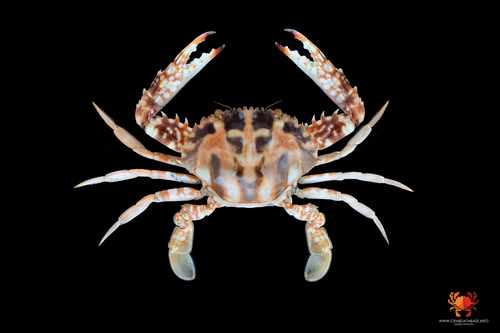
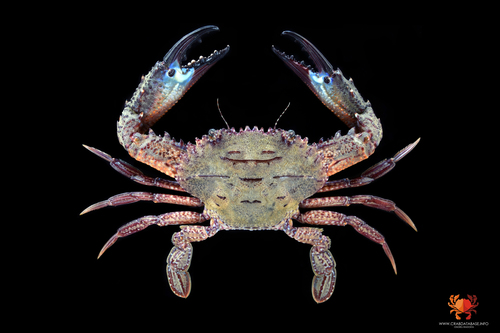
Charybdis natator, first described by Herbst in 1794, has a fan-shaped carapace. Its dorsal carapace surface ranges in color from brown to orange, while the ventral surface is bluish and mottled with white and pale red spots. Its legs are dark reddish-brown. The carapace is densely covered in short fine hairs, called pubescence, but this pubescence is absent from the distinct, granulated transverse ridges on its anterior surface. There are six spines along each side of the carapace. Between the closely set orbits sit eight small rounded lobes. The antennae are positioned outside the orbits, but their bases are in contact with the supraorbital lobe. The chelipeds (claws) are covered with large granules and/or scale-like squamiform markings. They have distinct black tips marked with blue spots, and bright blue coloration is also visible at the base of the cheliped. The anterior border of the cheliped's merus segment bears three spines, with one additional distal spine on its posterior border. The carpus segment has a strong, thick spine at its inner angle, and three small spinules at its outer angle. The last pair of walking legs is flattened, and can be rotated in a propeller-like motion, which lets this crab swim in any direction. The maximum recorded body size is 17 centimeters. This species occurs across the Indian and Pacific Oceans. Its range extends from eastern South Africa and Madagascar north to the Red Sea, across the entire Indian Ocean including the Mascarene Islands and Seychelles, into the western Pacific Ocean. In the western Pacific, it reaches north to Japan and south to northern Australia, including Lord Howe Island. In terms of human use, it is not an important fishery species in eastern Africa. In India, it ranks as the fourth most important swimming crab caught in commercial crab fisheries. In Taiwan and Australia, it is a much more important fishery species than it is in eastern Africa. Due to its high rate of meat recovery, Charybdis natator may be suitable for aquaculture.