About Charybdis hellerii (A.Milne-Edwards, 1867)
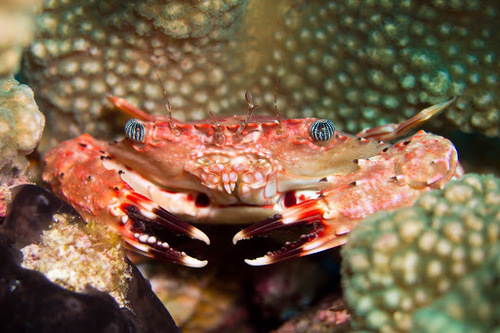
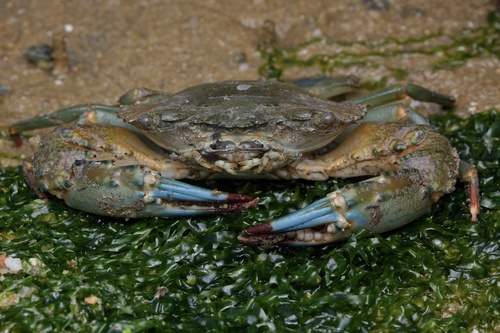
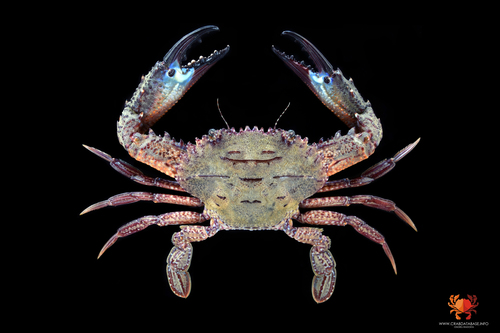
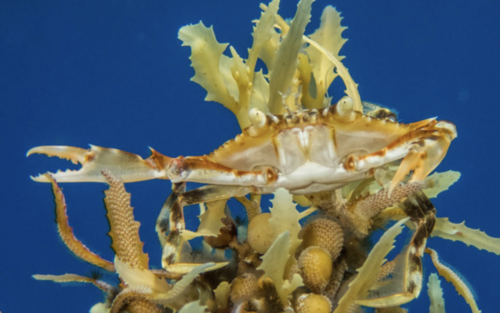
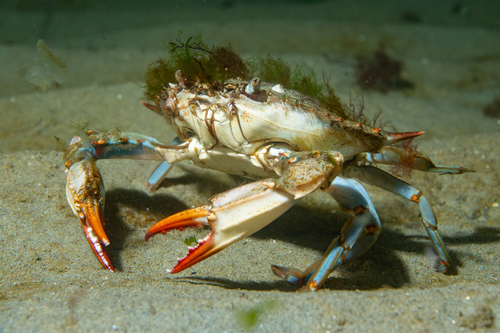
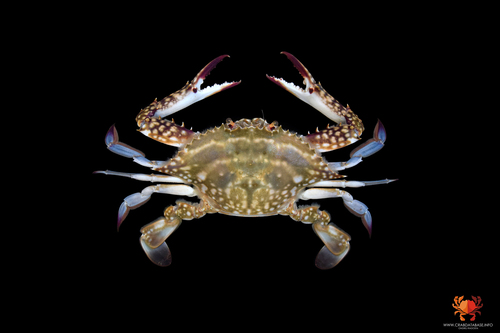
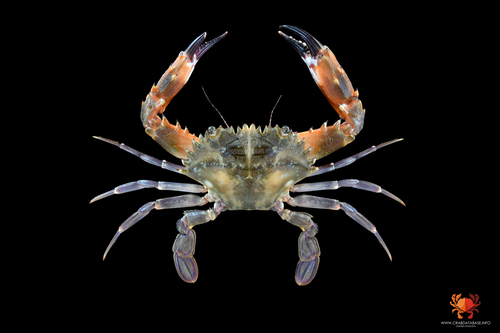
Charybdis hellerii has a convex, hexagonal carapace covered in long, soft hairs. Grainy transverse ridges are present on the frontal, protogastric, mesogastric, and branchial regions of the carapace. There are six prominent frontal teeth: two sharp inner orbital teeth, plus four blunt submedian teeth. The median teeth have an elliptical lower plane that projects past the submedian teeth, while the lateral teeth are sharply triangular, separated from the submedian teeth by a deep V-shaped cleft. The inner supraorbital lobe is roughly triangular, and the outer infraorbital lobe has a convex margin. There are six sharp teeth along the anterolateral margin, each with a black, brown, or red tip, separated by deep notches; the most anterior of these teeth is the smallest. The basal antennal article is swollen, which keeps the antennal flagellum outside of the orbit. The claws are large and unequal, covered in short, fine hairs. There are three spines on the anterior margin of the merus, and a small spine near the claw tip. The carpus has a strong spine on its inner margin and three ridges on its outer surface. The chela has four spines on its upper surface, one single spine close to the carpal joint, and a smooth lower surface. The merus and carpus of the fifth leg each have a spine on the posterior margin; the posterior margin of the propodus is toothed, and the dactyl is oval-shaped. In males, the first pleopod tapers and curves toward its spined tip. The carapace is mottled brownish-grey; the spines on the chelipeds have brown tips, and the claw fingers are black distally with white tips. This species occurs across a range of habitats from the intertidal zone down to around 50 m deep. It can be found on softer substrates including sand or mud flats so long as some stones are present, and also on hard substrates where it hides under rocks, among live corals, in tidal rock pools, within Thalassia meadows, and on Rhizophora mangle mangrove roots. Juvenile Charybdis hellerii have been observed living in association with the bryozoan Schizoporella unicornis. Charybdis hellerii is cultivated in the Philippines and commercially harvested by fisheries elsewhere in Southeast Asia. Where it is a non-native species, it has no market value and is not exploited.