About Charybdis feriata (Linnaeus, 1758)
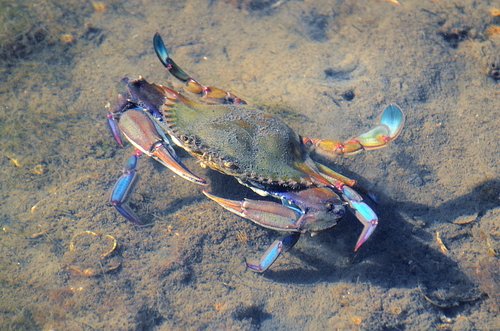
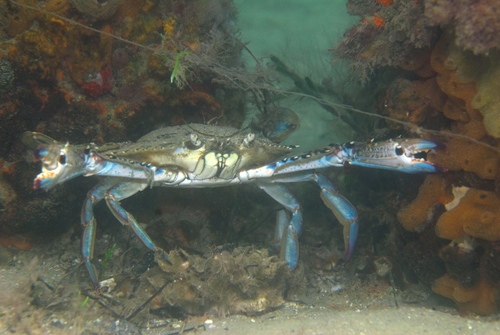
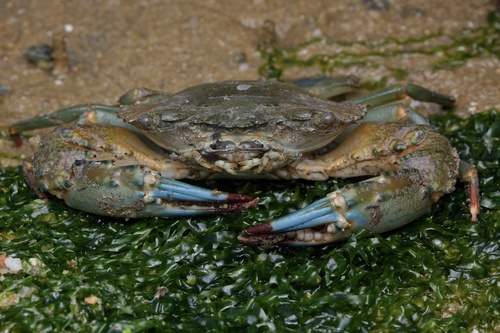
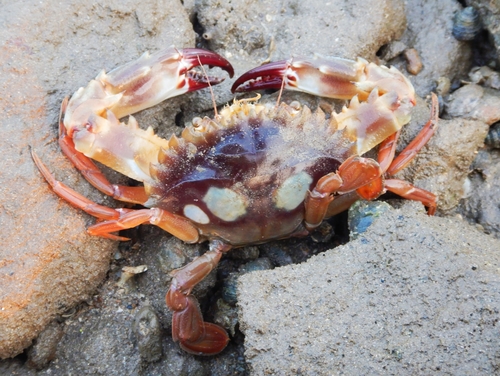
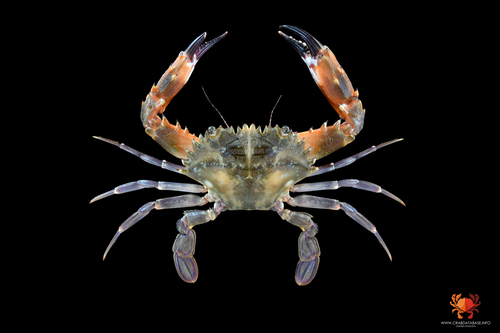
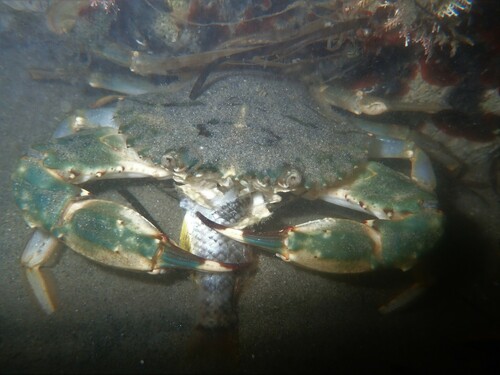
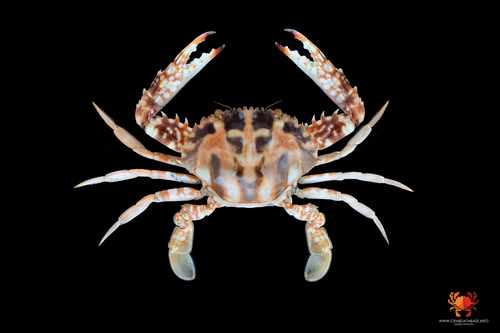
Charybdis feriata, commonly called the crucifix crab, grows to a carapace width of around 20 cm (8 inches). Its body is fan-shaped, and its carapace is smooth, marked by several granular transverse lines. The front edge of the carapace has six triangular teeth of roughly equal size; each side of the carapace has six larger truncated teeth that vary in size. This species has closely set eyes. There are three spines on the carpus of the cheliped (pincer leg), with smaller spines on the other joints of the limbs. The hindmost pair of walking legs (pleopods) are paddle-shaped, and are used for propulsion when the crab swims. The carapace has a bold cream and brown pattern, and often features a distinctive white cross on a dark background at its center. The crab's common name comes from this cross-shaped marking on the carapace. A Catholic tradition holds that Jesuit priest Francis Xavier lost his crucifix during a storm in Indonesia, possibly while attempting to calm the waters. The next day, when Xavier was on shore, a crab emerged from the sea holding his crucifix in its pincers. Saint Francis blessed the crab, and the species has carried the cross-shaped mark on its shell ever since. Some Catholics venerate this crab, and its shells are sometimes sold as religious trinkets or good luck charms. Charybdis feriata is native to the tropical and subtropical western Indo-Pacific region. Its native range stretches from East Africa, the Red Sea and the Persian Gulf east to Japan, Indonesia and Australia. It is uncommon in Australia, but is harvested commercially in parts of its range such as India. In February 2022, fishermen caught a female specimen off the Genoese coast, near the Lanterna landmark, at a depth of around 50 meters using a lobster trammel net. After being reported to the DISTAV Fishing Biology Laboratory of the University of Genoa, the specimen was moved to the Mediterranean department of the Genoa Aquarium, to be placed in curatorial tanks for behavior observation. This was not the first recorded sighting or capture of the species in the Mediterranean Sea. It was first recorded in 2004 in the seas off Barcelona, Spain; the second record came from Livorno, Italy in 2015; and the third was another Spanish record near Tarragona in 2017. Charybdis feriata lives in shallow water, on both rocky and sandy bottoms. Mating occurs between a hard-shelled male and a soft-shelled female that has just moulted. Before the female moults, the male takes up a guarding "cradle" position, straddling the female and gripping her with his walking legs. He dismounts while she moults, helping her detach her old shell, before returning to the cradle position. Copulation begins a few hours after moulting: the male turns the female over with his chelipeds and walking legs. The female then positions herself underneath the male, but faces the opposite direction, with her abdomen extended, and the male inserts his gonopods into her genital openings. This mating position is held for around seven hours, during which the male may move around with the female still attached. After copulation, the male returns to the cradle position for another few hours, while the female stays inactive until her new shell hardens. Spawning occurs roughly 17 days after mating. Like other crabs, the female Charybdis feriata carries her fertilised eggs under her abdomen.