About Charonia variegata (Lamarck, 1816)
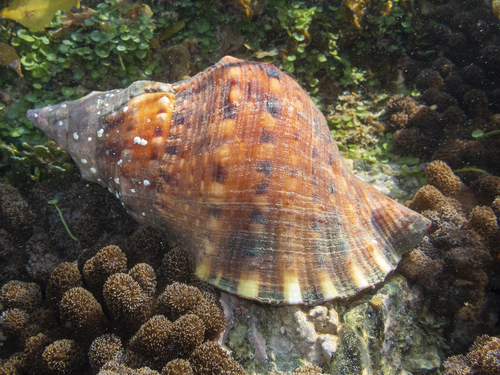
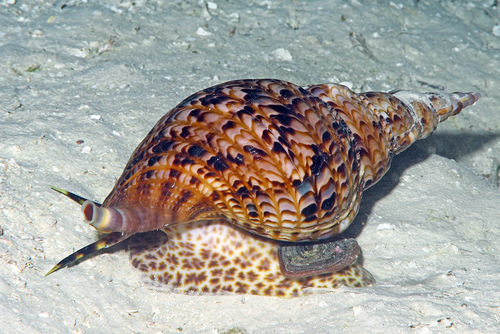
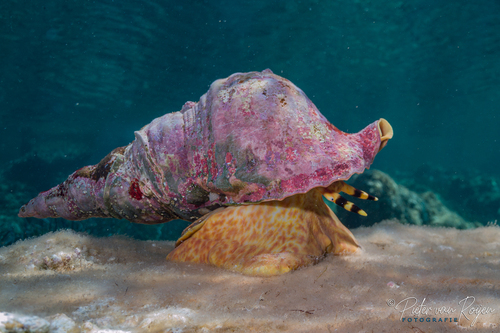
This species, Charonia variegata, has a shell that reaches up to 375 millimeters (14.8 inches) in size, with the maximum recorded shell length measuring 374 millimeters (14.7 inches). Its conical shell has an elongated, sharply pointed spire that lacks any knobs, and is somewhat squatter than the spire of the Pacific species Charonia tritonis. The lower whorls are unevenly swollen with a varix and bulge over the suture, which then descends in an uneven spiral. The parietal callus is lined with a narrow, dark inner lip, covered in regularly spaced, brown, rib-like plicae. The outer lip is scalloped but less projected, and bears toothing with around 10 pairs of rib-like teeth superimposed on square, dark brown blotches. The shell surface is mottled in shades ranging from creamy white to yellow, with brown markings. The inside of the large aperture is orange pink, and the shell's interior is white. This species is highly variable, and no geographic subspecies are currently known. Its veliger larvae have a pelagic development period of over three months, drifting in trans-Atlantic currents. These larvae are the largest known of any Ranellidae found in the Atlantic; the fully developed larval shell reaches 5 millimeters (0.20 inches) in size. Charonia variegata has a wide distribution. It has been recorded in European waters, the Mediterranean Sea, the Atlantic Ocean off Macaronesia, North West Africa, and Tanzania, the Caribbean Sea, the Gulf of Mexico, and along the Atlantic coast from North Carolina to eastern Brazil. Its recorded depth range spans from a minimum of 0.3 metres (0.98 ft) to a maximum of 110 metres (360 ft). Thin-shelled 'crabbed' specimens have also been found in traps off the west coast of Barbados, at depths between 155 and 185 metres (509–607 ft).