About Charonia lampas (Linnaeus, 1758)
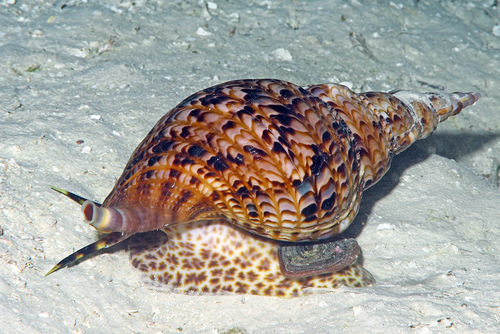
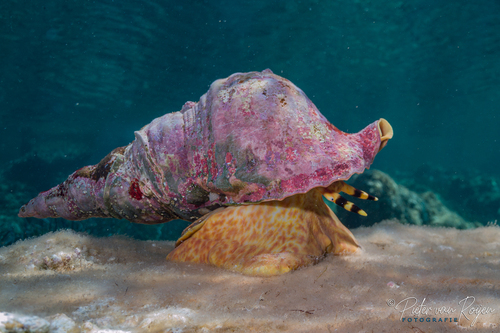
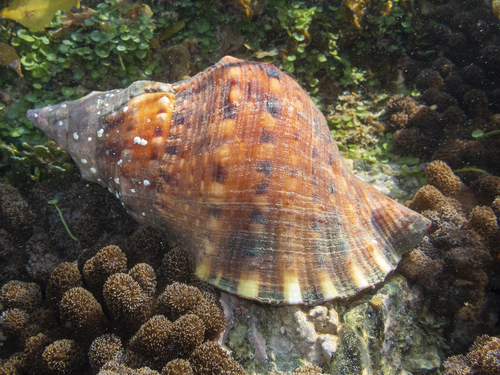
Charonia lampas (Linnaeus, 1758) is a marine gastropod species. The maximum recorded shell length for this species is 390 mm. On mainland locations, large shells can measure up to 400 mm, while shells from island and seamount sites only grow up to 200 mm. Its protoconch is multispiral, and is normally eroded except in very juvenile specimens. The teleoconch is made up of 8 to 9 whorls, with a moderately high, conical spire and convex whorls. The final whorl is large and accounts for slightly more than two-thirds of the shell's total height. The spire whorls are vaguely shouldered, bearing very flat spiral cords separated by poorly defined, rather narrow interspaces. The shoulder is covered by a much broader and flatter cord, and commonly but not always bears a spiral series of knobs. On the abapical side, this series is paralleled by smaller flat cords that may or may not have spiral rows of knobs. The large aperture is oval-shaped, with an elaborate peristome. The outer lip is flaring, thickened a short distance from the edge, and bears internal denticles. The inner part of the peristome has an appressed parietal callus that extends into a foliated columellar callus. In large specimens, this callus has a raised edge that overhangs the siphonal canal, and bears indistinct ridges near the edge. The colour pattern of the shell is very characteristic: articulated spiral bands with light patches on the knobs and dark brown in the interspaces, alternating with uniform medium brown bands. The peristome is white, with dark brown denticles on the outer lip, and a brownish to reddish hue on the edge of the columellar callus. This marine species has a wide distribution, found in the North Sea, the North Atlantic Ocean (Azores, Madeira, the Canaries, Cape Verdes), the Atlantic Ocean off African coasts, the Mediterranean Sea, and the Indian Ocean off Madagascar and the east coast of South Africa. It occurs at depths between a recorded minimum of 8 m and a recorded maximum of 50 m. During the Neolithic period, Charonia lampas shells were used in necklaces. There is evidence that these shells were also used as wind musical instruments.