About Charixena iridoxa (Meyrick, 1916)
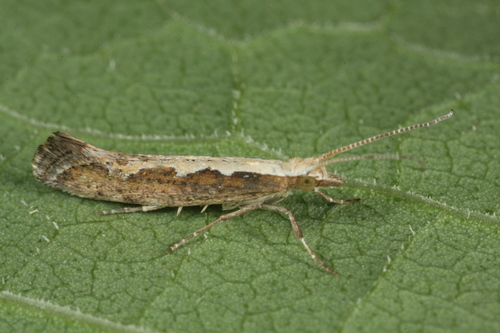
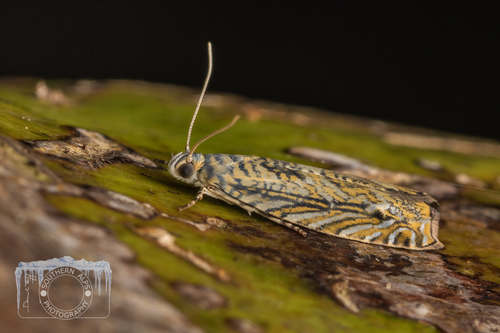
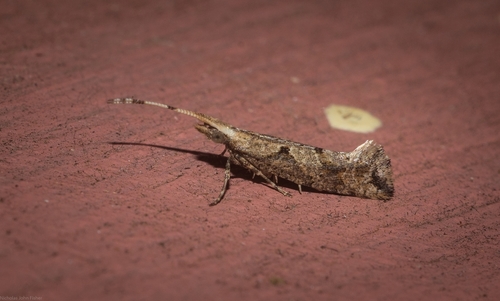
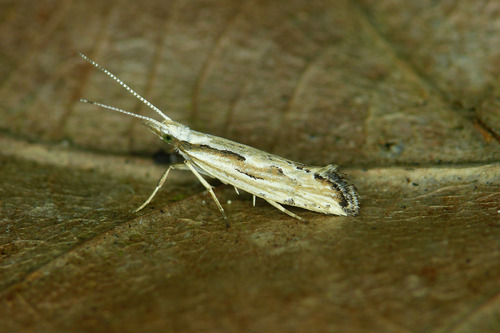
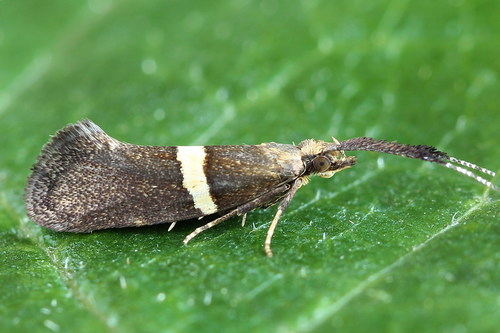
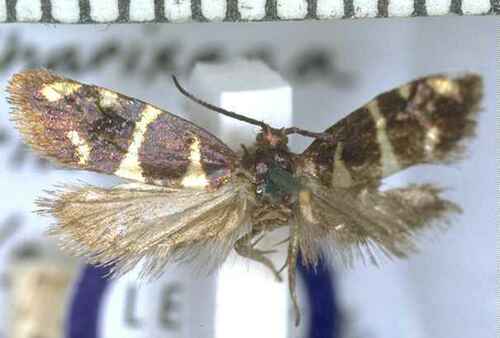
Charixena iridoxa (Meyrick, 1916) is a moth species endemic to New Zealand. Watt provided the following description of the full-grown larva of this species: A mature larva measures 21 mm or more in length, with a cylindrical, spindle-shaped body. Its greatest diameter is around 3 mm at the third abdominal segment, and the body tapers significantly toward both ends. To the naked eye, the larva appears legless because its legs are very small, and it moves very sluggishly when exposed. Body segments are shallowly incised, with the exception of the seventh and eighth abdominal segments. Spiracles are small, brown, and circular. The head is small, flattened, and light brown. The general body color is transparent, shiny white. Tubercles and setae are minute and very inconspicuous. Watt also described the species' pupa and exposed cocoon: The cocoon is shallow and elliptical, with somewhat pointed ends that are depressed into the leaf. Its long axis runs parallel to the leaf's long axis, with an average size of around 15 mm by 3 mm. The pupa rests upright inside the cocoon, with its ventral surface facing inward. When newly formed, the pupa is pale creamy white; it later becomes light brown, with darker coloration on the dorsum, and turns black with pale markings on the wings before adult emergence. The pupa is somewhat compressed dorsoventrally, and the ventral surface is more or less keeled or prominent along the midline. This gives a transverse section taken around the fourth abdominal segment a broadly triangular shape. Meyrick described the adult of the species as follows: Both male and female adults have a wingspan of 14-15 mm. The head and thorax are purple-coppery-metallic. The antennae are deep purple, and the abdomen is dark fuscous. The forewings are elongate, and slightly dilated posteriorly (more so in males). The costa is gently arched, the apex obtuse, and the termen obliquely rounded. Forewings are coppery-purple with a strong peacock-blue gloss, and markings are ochreous-whitish. There are slender transverse fasciae at 1/4 wing length and at the middle, which widen triangularly on the dorsum (more strongly in males); the first fascia does not reach the costa. A triangular or wedge-shaped spot sits on the costa at 2/3 wing length, a more elongate spot is on the costa toward the apex, and there is a narrow, posteriorly oblique mark from just before the tornus. Cilia are bronzy-grey, with the basal third being coppery-blue-purple. Hindwings are dark grey in males and grey in females, with grey cilia. This species is distributed from the middle of the North Island southward, including the South Island and Stewart Island. It has been collected in the Hunter Mountains, Ruahine Mountains, on Mount Taranaki, at Mount Arthur and Arthur's Pass, in Otago, at Lake Te Anau, and in Milford Sound. Mount Te Aroha is the northernmost known location where this species occurs. Though the moth is widespread, as shown by the common occurrence of its larvae feeding on Astelia species, adult moths are rarely observed. This species inhabits forests and mountainous terrain just above the tree line, where its host plants grow in abundance. The larval host plants of C. iridoxa are species in the plant genus Astelia, including Astelia fragrans and Astelia nervosa. Larvae of C. iridoxa live below ground inside the bulb of their host plant and take at least two years to mature. They mine the underside of host plant leaves from inside the plant's bulb, and the mine becomes visible as the leaf grows. These leaf mines have a distinctive zig-zag shape. When ready to pupate, the larva moves upward onto the plant leaf and pupates inside a cocoon formed within the leaf. As the leaf grows, the cocoon, which is attached to the leaf, moves further away from the plant's bulb. Pupation occurs between February and August, and adults emerge in early spring. This emergence timing likely explains why adult moths are observed so rarely, despite the species being widespread and abundant.