About Charina bottae (Blainville, 1835)
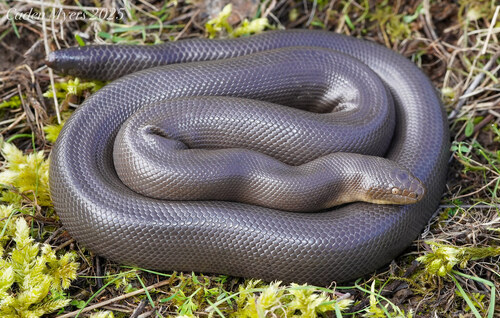
Charina bottae, commonly known as the rubber boa, is one of the smaller boa species. Adult rubber boas range from 38 to 84 cm (1.25 to 2.76 ft) in length, while newborns are typically 19 to 23 cm (7.5 to 9.1 in) long. Their common name comes from their skin: it is often loose and wrinkled, covered in small, smooth, shiny scales that give the snakes a rubber-like appearance and texture. Their base color is most often tan to dark brown, with a lighter underside, though they can sometimes be olive-green, yellow, or orange. Newborn rubber boas are usually pink and slightly transparent, and darken in color as they age. They have small eyes with vertically elliptical pupils, and short blunt heads that are no wider than their body. One of their most identifiable features is a short blunt tail that closely resembles the shape of their head. Rubber boas are visually distinct from nearly all other species that share their range, with the possible exception of the southern rubber boa, making them usually easy to identify. Rubber boas are the most northerly species of all boas. Their distribution covers a large area of the western United States, stretching from the Pacific Coast east to western Utah and Montana, south to central California, and north to southern British Columbia, Canada. There have also been rare sightings in Colorado and Alberta, outside of the regions where they are known to thrive: California, Oregon, Washington, Nevada, Utah, Wyoming, Montana, Idaho, and their northernmost range in British Columbia, around Pemberton, Williams Lake, and Radium Hot Springs. Rubber boas inhabit a wide variety of habitat types, including grasslands, meadows, chaparral, deciduous and conifer forests, and high alpine settings. They can be found at elevations from sea level to over 10,000 feet (3,000 m). They are less tolerant of higher temperatures than other snake species, and cannot live in areas that are too hot and dry, but can survive in surprisingly cold areas for a snake. They spend a large amount of time under shelter such as rocks, logs, leaf litter, and burrows, so they require habitats that provide this shelter, along with adequate warmth, moisture, and prey. It is thought that rubber boas maintain relatively small home ranges, as many individuals are recaptured in the same vicinity year after year, though individual snakes may occasionally migrate due to competition, lack of prey, or other pressures. Rubber boas are viviparous, meaning they give birth to live young. They can produce up to 9 young per year, though litters of 1 to 5 are far more common. They are less prolific than many other snakes native to the US and Canada; females reproduce on average only once every four years. Mating occurs shortly after rubber boas emerge from brumation in the spring, and young are born between August and November of the same year.