About Charaxes pelias (Cramer)
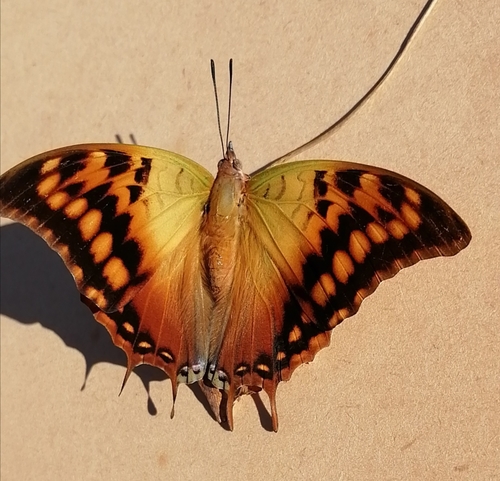
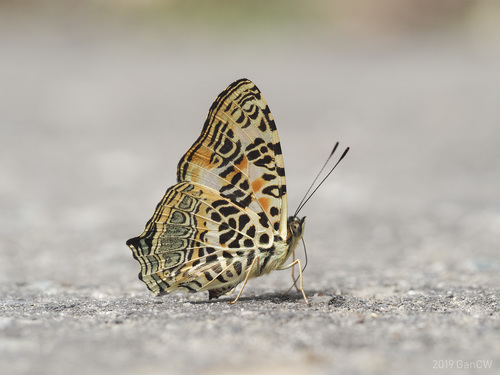
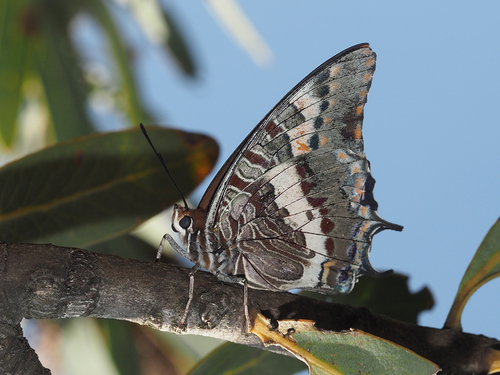
This butterfly species, Charaxes pelias (Cramer), has a wingspan of 60–70 mm in males and 65–75 mm in females. Each hindwing has two tails, with the upper tail being noticeably shorter than the lower. Typically, four submarginal blue spots are present on the hindwing, growing larger toward the anal angle. The orange-yellow postdiscal band on the forewing is split into two sections from the costa to at least halfway down the wing. The underside features a mosaic pattern of mixed blackish-brown bands, with dark grey and grey-brown patches bordered by silvery-white filigree, giving the underside a clear silvery grey appearance. According to Seitz, Charaxes pelias has almost identical markings to Charaxes castor, but is smaller and much paler overall. The basal area of the upper wing surface is dark red-brown, the light-bordered markings on the underside are grey-centered; the upper surface discal band is orange-yellow, and the orange-yellow marginal spots on the forewing are large and distinct. The underside discal band is white: on the forewing it is bordered distally by triangular orange-yellow spots, while on the hindwing it is bordered by deep red-brown spots. The ground color of the basal underside is red-brown. For the pelias Cr. type form, the black spots in the forewing upperside discal band across cellules 2 to 7 are as large as, or larger than, the triangular orange-yellow spots they separate; the black marginal line of the hindwing is very thick; on the hindwing underside, the red-brown spots on the distal side of the white discal band are very small and much narrower than the band itself. This type form is found in the mountainous western regions of Cape Colony. Its larva is thought to feed on Protea grandiflora, the "Wagenboom". What was previously classified as saturnus Btlr. is now recognized as the full species Charaxes saturnus. In Charaxes saturnus, the black spots in the forewing discal band are smaller than the orange-yellow spots they border proximally; the black marginal line of the hindwing is much thinner than in the Charaxes pelias type form; on the hindwing underside, the red-brown spots are large and at least as wide as the discal band; the upper surface marginal spots are sometimes only slightly larger than in the pelias type form, and sometimes very large. Charaxes saturnus ranges from Natal to the Congo and British East Africa. The aberrant form laticinctus (brunnescens Rothsch.) has a brown-black basal area on the upper wing surface, a darker orange-yellow discal band than that seen in saturnus, and small, brown marginal spots. This aberrant form occurs in North Angola. According to Van Son, Charaxes pelias is superficially similar to Charaxes saturnus Butler, but can be distinguished by the following traits: smaller overall size; lighter orange-yellow markings on the upperside; hindwing discal band that is broader toward the posterior (not triangular) and extends to vein Cu2; greatly reduced orange markings on the forewing underside; much darker transverse red-brown markings in basal areas and red-brown spots beyond the hindwing discal band, with these markings completely absent in the anal area; much shorter hindwing tails; higher antenna to wing ratio; and numerous additional differences in genitalia, early life stages, and larval food plants.