About Charaxes marmax Westwood, 1848
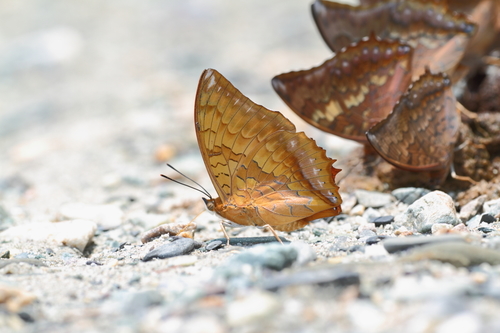
Charaxes marmax Westwood, 1848 shows distinct sexual dimorphism in its wing pattern and morphology. In males, the upper surface of the wings has a rich ochraceous tawny base color. On the forewing, there is a black subcostal spot at the discocellulars, with a pale chestnut line on each side of this spot. A very short, slightly curved narrow discal band runs from vein 7 to vein 5. A broad oblique postdiscal band extends from the costa to vein 6, and a broad jet-black terminal band runs from the apex to vein 1. The extreme edge of the termen is marked with interrupted patches of fulvous tawny. The postdiscal band continues as a curved, lunular narrow chestnut band reaching vein 1, and the black color at the apex continues along the costa to join the postdiscal band above. On the male hindwing, the costal margin is broadly pale yellow. The terminal third of the wing is a darker tawny shade than the wing base, with a short broken black discal line running from the costa to vein 6. There is a slightly curved subterminal series of outward-pointing black spots, which increase in size toward interspace 6; the two spots near the tornus are centered with white. The terminal margin is somewhat broadly dark reddish brown. The underside of male wings is bright ochraceous yellow. Both forewings and hindwings are crossed by characteristic sinuous black lines, with the postdiscal line forming lunules on its outer side. On the male forewing, the discocellulars are outlined by dark lines, and the apex has two short white streaks that continue as a line of faint white dots to interspace 1. On the male hindwing, the areas between the wing base and the subbasal dark line, and between the two median dark lines, are a darker ochraceous shade than the overall ground color. Beyond the postdiscal lunular line there is a dark shade, which is crossed by a series of heavy slate-black lunules and faint, black-tipped white dots. The terminal reddish-brown band matches that seen on the upper side of the wing. Male antennae are black and ringed with white; the head, thorax, and abdomen are tawny, and paler on the underside; the palpi are white. Females are similar to males overall, but the ground color of the wing disc is paler. On the female forewing, the short discal band is much broader, and continues as a series of lunules in the interspaces to vein 1. The postdiscal lunular line is slender in its upper portion, does not connect to the black on the termen, and may be either black or chestnut-colored. The black marking on the margin is shaped into a subterminal series of large black spots that are conical toward the wing base, and the termen beyond these spots is dusky ochraceous. On the female hindwing, the subterminal row of black spots each have a very short transverse white line through their center. The underside of female wings is largely similar to that of males, but the slate-black lunules on the hindwing form a broad, obliquely placed line. The subterminal series of white spots on both forewings and hindwings are larger and more visible than in males; the upper tail is spatulate and much longer than in males. This species is distributed in Northeastern India (Sikkim, Assam), Bhutan, Burma, Peninsular Malaya, and Indochina.