About Charaxes jasius saturnus Butler, 1866
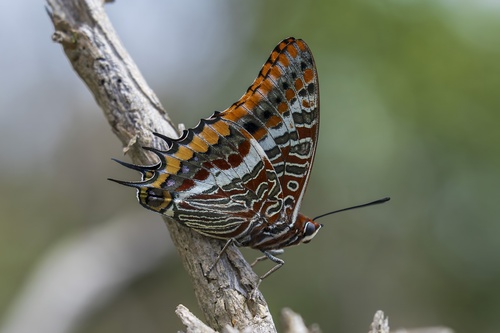
Charaxes jasius is a medium to large butterfly. Males typically have a wingspan of 76–83 mm, and females are larger. In Morocco, males may reach 80–100 mm wingspan, with females growing even larger there. Each hindwing has two tails, a feature characteristic of most species in this genus. The spring seasonal brood is smaller in size than the second and sometimes third broods. In the spring brood, the two tails on each hindwing tend to curve toward each other, resembling a pincer. Later broods show less of this curvature, and have slightly longer, straighter tails. The upperside ground colour of the wings is dark brownish-black, with a changeable purplish sheen that appears different when viewed at varying angles. The forewing has faint darker discal bars and orange postdiscal spots. The hindwing has a whitish patch near the costal border, dusted with brownish scales. The outer border of both wings is deep orange-ochreous, divided by black-scaled veins. The hindwing has small submarginal blue spots, which are often vestigial; these spots are more developed in females. There is some variation in the intensity of the ground colour, and in how developed the postdiscal orange spots are. The underside has a very characteristic mosaic appearance broadly similar to that of many related species. It is crossed by a mix of bands and patches of brown, reddish, greyish and blackish, all edged with a white filigree. Beyond this inner mosaic, a complete white discal band connects the forewing to the hindwing. The outer orange marginal coloration found on the upperside is also present on the underside. Females match the appearance of males but are larger. This species occurs along the European Mediterranean coast from western Portugal to the coastal islands of Greece, with the exception of the northern Adriatic sea coast. Its range extends from the central and south Italian peninsula to Istria, and along the coastline of southern Anatolia, including the islands of Samos, Ikaria and Rhodes. It can also be found on the Balearic Islands, Corsica, Sardinia, Corfu and Crete. Inland, the butterfly is found locally in Spain from Huelva and Málaga to Madrid and Salamanca. In France, it occurs in isolated inland areas from Provence to Lozère, Ardèche and Aveyron. Further along the Eastern Mediterranean coast, it is present in Turkey, Lebanon, and Israel. It continues along most of the North African coast to the Atlantic north-western coast of Morocco, reaching as far as the area around coastal Tiznit, and ventures into a very few inland Moroccan locations at elevations as high as 2,400 metres above sea level. The typical habitat of Charaxes jasius in the Mediterranean Basin is maquis shrubland, up to 700–800 metres above sea level. This habitat consists of thick, mixed scrub forests, often on hillsides, in hot and dry regions. The butterfly is found anywhere its larval host plants grow abundantly. Charaxes jasius is bivoltine or trivoltine, meaning it has two or three generations per year depending on latitude and altitude. Typically, the first set of eggs is laid in May–June, and the second between mid August and mid October. Caterpillars from the second batch overwinter in the larval stage, and pupate the following spring. Females lay eggs on the upper surface of host plant leaves, placing no more than one egg per leaf. The caterpillar is green, cylindrical, and reaches up to 50 millimetres (2.0 in) long. It has rings of raised yellow-white spots across its body, yellow lateral lines along its sides, and two yellow ocelli on its back. Four backward-facing horns grow from its head. The caterpillar builds a leaf tent with silken threads, and returns to this tent after feeding on surrounding leaves. When fully mature, the caterpillar hangs from a twig and pupates. The pupa resembles a ripening fruit: it is green at first, and turns brown as the adult butterfly develops inside it. After a period ranging from two weeks to one month, the pupal case opens to release the adult butterfly. The preferred larval foodplant is the strawberry tree (Arbutus unedo). A small number of Osyris species are known to be secondary or possibly accidental larval food choices.