About Charaxes cithaeron Felder, 1859
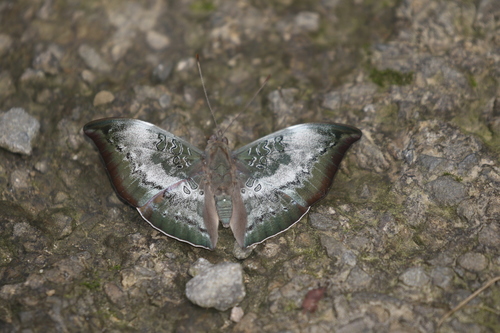
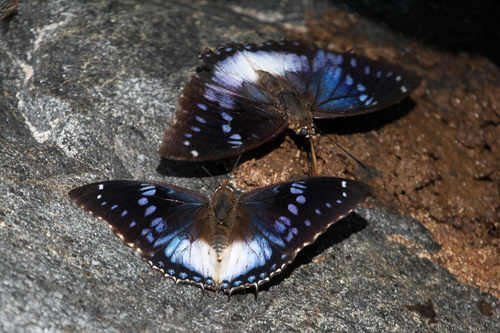
Charaxes cithaeron was first described by Felder in 1859. The wingspan of this species ranges from 70–80 mm in males and 85–95 mm in females. For male Ch. cithaeron: The forewing upperside is black and marked with two transverse rows of spots; the proximal row sits in the middle of the wing, contains 6 spots total (2 in cellule 1b, and one each in cellules 2 through 5), and all spots in this row are blue. The distal row contains 8 spots total; the first two spots, in cellules 6 and 7, are white, while the rest are blue. Beyond the middle of cellule 1a, there is an elongate blue spot. Beyond its middle, the hindwing upperside has a broad transverse band that is whitish toward the posterior and blue toward the anterior. It also has blue submarginal spots and whitish marginal streaks. The basal portion of the underside has irregularly arranged, black transverse streaks with white edges. On the upperside, females have a broad, curved white transverse band on the forewing that is sharply defined on its proximal edge, and a bluish white transverse band on the hindwing. Because of this pattern, females are very similar on the upperside to female Charaxes violetta. This species occurs in forested habitats, ranging from the coastal belt to the Kenya Highlands. A full formal description was also published by Walter Rothschild and Karl Jordan in 1900, on pages 379–382 of Novitates Zoologicae Volume 7 (287–524); see Novitates Zoologicae Volume 5: 545–601 for explanation of descriptive terms.