About Charadrius morinellus Linnaeus, 1758
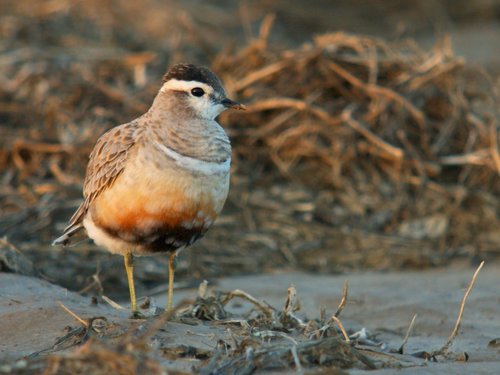
This plover species is smaller and more compact than the European golden plover (Pluvialis apricaria). It has a prominent whitish supercilium in every plumage, and its wings are plain when in flight. Summer adults are easily identified: they have a chestnut breast bordered above by white, a black belly, and a warm-brown back. Their legs are yellow, and their short bill is black. Like phalaropes, female dotterels are brighter in colour than males. Winter individuals lose the rich colouration of their underparts, only retaining the white breast line, and are greyer on their upperparts. Young birds look similar to winter adults, but have a scaly pattern on their backs. The species' flight call is a soft pyurr, and the female's song is a simple, repetitive whistle. This species breeds in Arctic tundra across northern Eurosiberia, ranging from Norway to eastern Siberia, and also on suitable mountain plateaus including the Scottish Highlands and the Alps. It is a migratory species, and winters in a narrow belt across North Africa that extends east from Morocco to Iran. Migration stopover sites are traditional, and small groups of dotterel pass through these typically inland arable or grassy sites each year. The species' winter habitat is semi-desert. The dotterel's diet consists of insects and other small invertebrates, including snails, worms, and shellfish. It catches prey using a run-and-pause foraging technique, instead of the steady probing method used by other waders. Generally, male dotterels are responsible for incubating eggs and caring for chicks. In most cases, a male dotterel successfully prevents other males from mating with his partner and fertilizing her eggs. He usually only raises chicks that he has fathered; only 4.6% (2 out of 44) of chicks are not the genetic offspring of the caring male, which corresponds to 9.1% (2 out of 22) of broods being affected.