About Charadrius melodus Ord, 1824
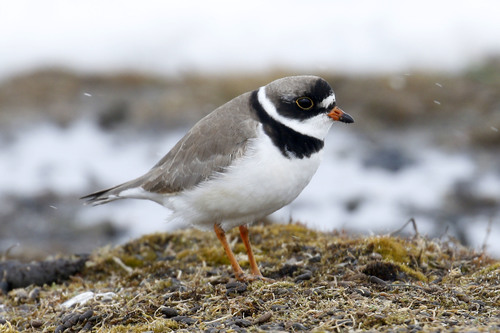
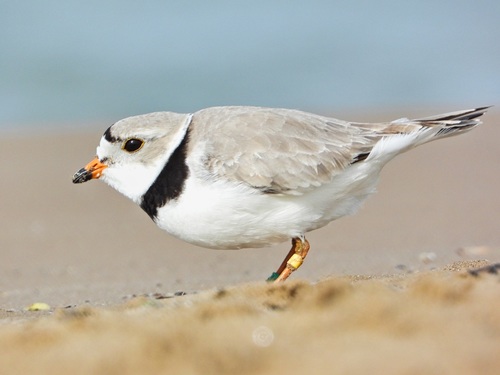
The piping plover (Charadrius melodus Ord, 1824) is a stout sparrow-sized shorebird. It has a large rounded head, short thick neck, and stubby bill, with sand-colored dull gray or khaki plumage. Adults have yellow-orange legs and an orange bill with a black tip. During the breeding season, males have a prominent black band across the forehead between the eyes and a black ring around the neck, while females have a much fainter black brow band. Black markings become less pronounced during the nonbreeding season. The species measures 15–19 cm (5.9–7.5 in) in length, has a wingspan of 35–41 cm (14–16 in), and weighs 42–64 g (1.5–2.3 oz).
Piping plovers spend most of their lives on open sandy beaches or rocky shores, typically occupying high, dry sections away from water. They are found along the U.S. and Canadian Atlantic Coast on ocean or bay beaches, and along Great Lakes shores. They build nests higher on the shore, near beach grass and other objects. It is very rare to see piping plovers outside sand or rocky beaches when they are not migrating. This species is disturbance-dependent, as its habitat relies on severe flooding. Piping plovers need nesting sites that stay dry through the entire nesting period far from water, but also require open sand for nesting. This combination of conditions only occurs at sites that are thoroughly flooded once every few years, which deposits fresh sand and clears away vegetation. When human coastal management strategies reduced unpredictable flooding, historical piping plover habitats became overgrown and populations declined. Today, the U.S. Army Corps of Engineers artificially clears shoals on the Platte and Missouri River to maintain remaining piping plover habitat in the Great Plains, though these efforts are not as effective as natural periodically flooded habitats.
Along with least terns, piping plovers have an unusual relationship with mining: while most species lose habitat to mining activities, piping plovers nest on waste sand piles generated by nearby mines as a replacement for natural sand bars. These waste sand piles stay regularly topped and remain free of vegetation overgrowth as long as mining continues. When mining ends, sites are often reclaimed for housing development, extending the persistence of waste sand piles. However, modern mining practices typically transport most waste sand to more remote areas for commercial reuse, limiting opportunities for piping plovers to colonize these habitats.
Piping plovers are migratory: they spend summer in their northern range and move south for winter, migrating to the Gulf of Mexico, the southern Atlantic coast of the United States, and the Caribbean including The Bahamas. They have also been recorded across Cuba, with rarer occurrences elsewhere in the West Indies, and even in Ecuador and Venezuela. They begin migrating north in mid-March, with breeding grounds extending from southern Newfoundland south to northern South Carolina. Some adults and fledglings start migrating south in August, and most piping plovers have reached southern wintering grounds by mid-September.
A large portion of the piping plover's range lies in the Prairie Pothole Region of South Dakota, North Dakota, and Canada. The shallow wetlands of this region have fluctuating water surface areas that change with wet and dry periods. Breeding piping plovers here depend on lowered water levels to expose shorelines for nesting. Climate change, alongside consolidation drainage (draining smaller wetlands into a single larger wetland to create fewer, larger wetlands), has produced fuller wetlands, reducing available shoreline nesting habitat. Research of 32 piping plover wetland habitats in this region found that wetlands with raised water levels have a lower chance of hosting piping plovers. This indicates that warming climates, increased water levels, and increased precipitation will degrade piping plover breeding habitats in the Prairie Pothole Region.
On the other hand, research suggests that piping plover habitat in Nebraska, along the shoals of the Platte and Missouri Rivers and around Lewis and Clark Lake, may benefit from climate change. Climate change would cause extensive high-flow flooding events that prevent shoal overgrowth more often than they currently occur, bringing them closer to historical patterns from before European colonization of the Americas. The ideal frequency of high-flow events for piping plover population abundance in this river system is once every four years. Shoreline stabilization efforts have reduced these events to once every twenty years, which is not enough to maintain piping plover populations outside of artificially cleared shoals, which become the species' only long-term refuge. Climate change would only harm these overall populations if it made high-flow events occur more often than once every four years, or if it made the basin drier and reduced event frequency even further; both outcomes are considered unlikely. However, it is more plausible that in at least the near term, climate change adaptation efforts to protect human property in the area will continue to suppress high-flow events, canceling out this benefit for piping plover populations, while also making the area more vulnerable to an unprecedented catastrophic flooding event that could overwhelm flood management efforts and submerge all local piping plover subpopulations.
Climate change is also causing sea level rise that may affect the piping plover's other main habitat, the Atlantic Coast of the U.S. and Canada. Research assessing the threat of sea level rise to piping plover habitat on barrier islands in Long Island, New York, found that sea level rise will reduce the species' breeding areas. While breeding habitats can potentially migrate inland, human development will reduce the amount of available migrated habitat by 5 to 12%, leading to an overall net reduction. This may create conflict between piping plover habitat conservation and human recreation, as rising sea levels cause suitable habitats to take up a larger proportion of the islands. Research also shows that a large hurricane combined with elevated sea levels could flood up to 95% of piping plover habitat, so increased coastal storms driven by climate change paired with rising sea levels could be very damaging to the species.
Similar research on the Florida coastline, part of the piping plover's Atlantic coast habitat, evaluated habitat sensitivity to climate change-driven sea level rise. Coastal species in Florida are at particular risk from climate change due to both sea level rise and increased tropical storms. Piping plovers depend on this Florida habitat because they migrate south from breeding grounds to winter here for approximately three months each year. By 2100, it is predicted that 16% of coastal landforms will be lost to inundation. Additionally, sea level rise may make the coastline more complex, increasing habitat fragmentation. Changing coastal landforms in Florida will therefore likely alter piping plover ecology. Research also confirms that among shorebird species affected by transformation of the Florida coastline, piping plovers are at high risk of population decline.