About Charadrius leschenaultii R.Lesson, 1826
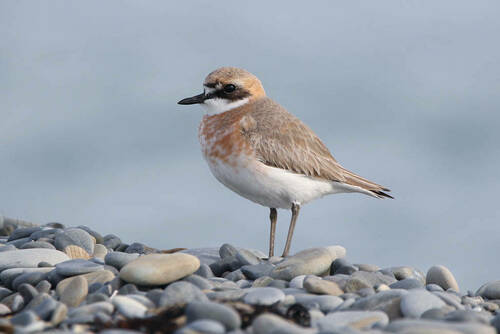
This chunky plover species measures 19–22 cm in length, slightly larger than the common ringed plover. It is noticeably long-legged with a thick bill. Breeding males have sandy buff-colored backs and white underparts; in summer, their breast, forehead, and nape show variable orange coloring, and they also have a black eye mask during the breeding season. Females are duller and greyer than breeding males, while winter adults and juveniles are browner, with just a faint rufous tint on the head. This species has greenish-yellow legs and a black bill. In all plumages, it is very similar to its close relatives, the Siberian sand plover (A. mongolus) and the Tibetan sand plover (A. atrifrons). Separating the species can be straightforward in mixed wintering flocks on Indian beaches, where differences in size and body structure are obvious. Identifying a lone vagrant in western Europe, however, is far more difficult, since both this species and its close relatives are very rare there. The identification challenge is made harder by the fact that the southwest Asian subspecies of the greater sand plover, which has a smaller bill, is the most similar in appearance to the other two related species. The greater sand plover breeds in semi-desert areas from Turkey eastward across Central Asia, where it nests in a bare scrape on the ground. This is a strongly migratory species, which winters on sandy beaches in East Africa, South Asia, and Australasia. It is a rare vagrant in western Europe, and has been recorded as far west as Iceland. It has been recorded three times in North America: the most recent sighting was on 13 April 2025 in Biscay Bay, Newfoundland and Labrador, and the prior North American sighting was on 14 May 2009 in Jacksonville, Florida. The greater sand plover feeds on insects, crustaceans, and annelid worms, catching prey using a run-and-pause foraging technique, instead of the steady probing used by some other groups of waders. Its flight call is a soft trill. This species is covered by the Agreement on the Conservation of African-Eurasian Migratory Waterbirds (AEWA).