About Charadrius hiaticula Linnaeus, 1758
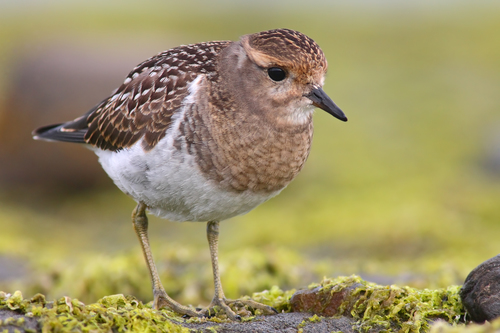
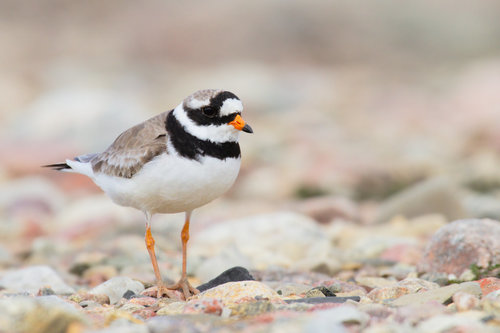
Adults of this species measure 17–19.5 cm (6.7–7.7 in) in length, with a wingspan of 35–41 cm (14–16 in). They have grey-brown backs and wings, a white belly, and a white breast marked with a single black neckband. They have a brown cap, a white forehead, a black mask surrounding the eyes, and a short orange and black bill. Their legs are orange, and only the outer two toes are slightly webbed. This distinguishes them from the slightly smaller but otherwise very similar semipalmated plover, which has slight webbing on all three toes and a marginally narrower breast band; semipalmated plover was formerly included within this species. Juvenile ringed plovers are duller in colour than adults, with an often incomplete grey-brown breast band, a dark bill, and dull yellowish-grey legs. This species differs from the smaller little ringed plover in leg colour, head pattern, and the absence of an obvious yellow eye-ring. The common ringed plover's breeding habitat is open ground on beaches or flats across northern Eurosiberia and Arctic northeast Canada. Some individuals breed inland, and in western Europe, they nest as far south as northern France. They are commonly found in both low coastal plains and cold uplands with sparse vegetation, occupying open habitats with little to no plant cover, where they nest on the ground. Common ringed plovers are migratory, and winter in coastal areas as far south as Africa. In Norway, geolocator tracking has shown that breeding adult birds migrate to West Africa. Many birds in Great Britain and northern France are resident year-round. These birds forage for food on beaches, tidal flats and fields, usually by sight. They eat insects, crustaceans, and worms, and forage during both the day and night. They sometimes use foot-trembling to reveal the location of their prey.