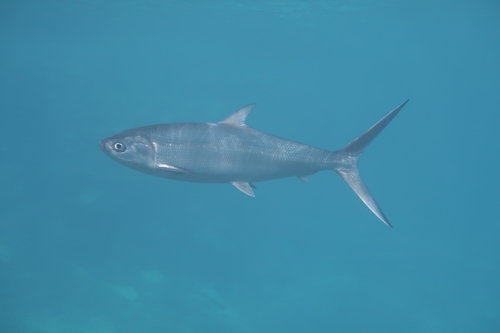
About Chanos chanos (Forsskål, 1775)
Introduction The milkfish, Chanos chanos, is a widely distributed ray-finned fish found across the Indo-Pacific. It is the only living species in the family Chanidae, and the only living member of the genus Chanos. Its scientific name is a tautonym (a repeating binomial name), derived from the Greek word khanos (χάνος, meaning 'mouth'). Milkfish are classified in the order Gonorhynchiformes, and are most closely related to Ostariophysi, a group that includes freshwater fishes like carps, catfish, and loaches. This species has many common names across its range. Its Hawaiian name is awa, and its Tahitian name is ava. In the Philippines, it is called bangús, where it is popularly called the national fish, although the National Commission for Culture and the Arts has stated this is not official, as it has no basis in Philippine law. The Nauruan language name for the species is ibiya. In Indonesia, it is called bandeng or bolu.
Geographic distribution Chanos chanos is found in the Indian Ocean and across the Pacific Ocean, ranging from South Africa to Hawaii and the Marquesas, from California to the Galapagos, north to Japan, and south to Australia. One single specimen was recorded in the eastern Mediterranean Sea in 2012. In 1877, the California Fish and Game Commission introduced 100 milkfish from Hawaii to the inland waters of Solano County, California. This introduced population was not able to establish a permanent population, and the impact of their introduction on the native ecosystem is still unknown. Milkfish most commonly live in tropical offshore marine waters near islands and along continental shelves, at depths between 1 and 30 meters (3 feet 3 inches to 98 feet 5 inches). They also frequently enter estuaries and rivers.
Habitat Adult milkfish tend to form schools around coasts and islands that have coral reefs. Young fry live at sea for two to three weeks, then migrate during the juvenile stage to mangrove swamps, estuaries, and sometimes lakes, before returning to the sea to reach sexual maturity and reproduce. Juveniles prefer to settle in undisturbed, semi-enclosed, calm, shallow coastal ecosystems that are free of predators and rich in aquatic vegetation. In their natural habitats, milkfish are highly adaptable to both changes in environmental conditions and changes in diet. They are effective osmoregulators and extremely euryhaline, meaning they tolerate a wide range of salinity. The wide geographic range of milkfish has resulted in genetic variation across Indo-Pacific populations; distinct genetic populations exist around the Hawaiian islands, the central Pacific islands, Tonga, Tahiti, Philippines-Taiwan-Indonesia, Thailand-Malaysia, India, and Africa. Despite this variation, all populations are thought to interbreed, so the entire group is classified as a single species, and overall genetic diversity across the species is low. Even so, different populations may differ in their reproductive, migratory, and survival strategies.

