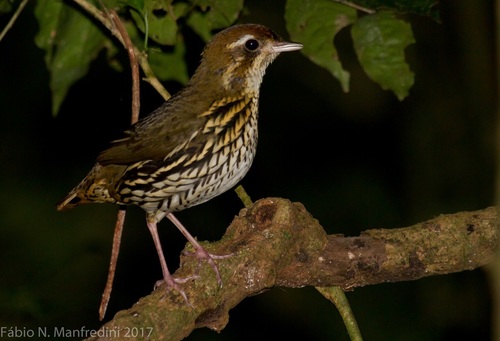
About Chamaeza campanisona (Lichtenstein, 1823)
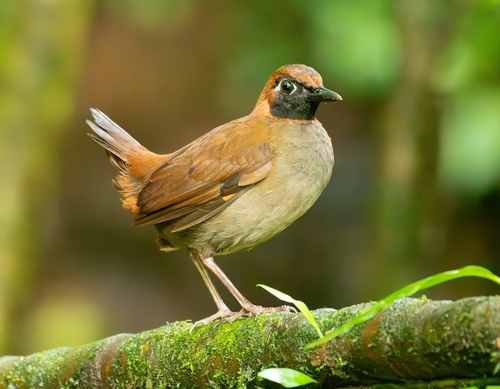
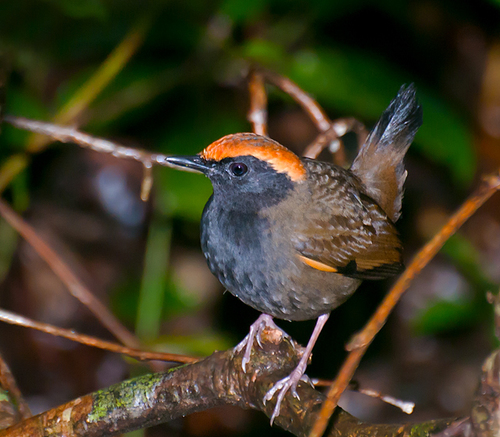
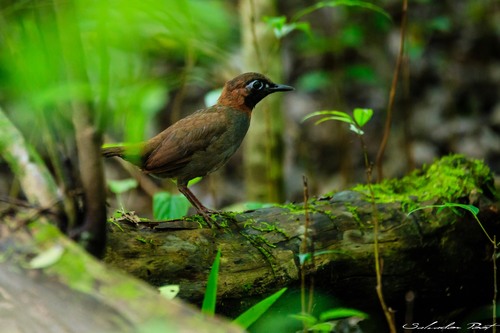
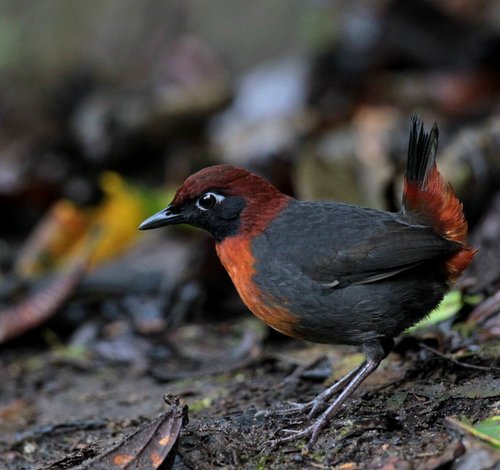
The scientific name of the short-tailed antthrush is Chamaeza campanisona (Lichtenstein, 1823). This bird species measures 19 to 25 cm (7.5 to 9.8 in) long and weighs 64 to 112 g (2.3 to 4.0 oz), and males and females have identical appearance. Adults of the nominate subspecies have a rufescent brown or brown crown with a black spot on the forecrown. Most of their face is brown, with white lores and a white streak behind the eye. Their back, wings, and uppertail coverts are olive brown. Their tail is brown, with a black band near the tip and thin buff or whitish tips on the individual feathers. Their throat is white, and most of their underparts are rich buff, with wide black streaks across the breast and flanks, and some black bars or spots on the crissum. Their iris is dark brown, their bill is black with a paler base to the mandible, and their legs and feet are brown or brownish gray. All other subspecies of the short-tailed antthrush share the basic pattern of the nominate subspecies, with only limited color variations. Variations between subspecies can include a blacker crown, buffy rather than white lores and postocular streak, more reddish brown and less olive upperparts, a whiter base color to the underparts, and differing amounts of streaking on the underparts. The short-tailed antthrush has a highly disjunct distribution, with each subspecies occupying a separate range. C. c. columbiana is found on the east slope of Colombia's Eastern Andes. C. c. punctigula ranges from Napo and Pastaza provinces in eastern Ecuador south into northern Peru, reaching the Marañon River. C. c. olivacea is found in east-central Peru, from the Department of Junín to the Department of Madre de Dios. C. c. huachamacarii occurs on Cerro Huachamacari and possibly other tepuis in southern Venezuela. C. c. berlepschi ranges from eastern Department of Cuzco in southern Peru east just into La Paz Department of western Bolivia. C. c. venezuelana is found in the Venezuelan Coastal Ranges. C. c. yavii occurs on Cerro Yavi and possibly other tepuis in south-central Venezuela. C. c. obscura is found on tepuis in Bolívar state (southeastern Venezuela) and southern Amazonas state (Venezuela), as well as on adjoining Brazilian tepuis. C. c. fulvescens occurs on Mt. Roraima in eastern Venezuela, on tepuis in western Guyana, and in central Suriname. C. c. boliviana ranges across central Bolivia from La Paz Department to Santa Cruz Department. C. c. campanisona (the nominate subspecies) is found in separate areas of eastern Brazil: in Ceará, Alagoas, and from Bahia south to Rio Grande do Sul; it also occurs in eastern Paraguay and northeastern Argentina. Across all its separate ranges, the short-tailed antthrush lives in humid foothill and montane forests and woodlands. In eastern Brazil, it also occurs in lowland evergreen forest. Its elevation range varies by location: it occurs between 500 and 1,800 m (1,600 and 5,900 ft) in Colombia, between 950 and 1,700 m (3,120 and 5,580 ft) in Ecuador, between 900 and 1,700 m (3,000 and 5,600 ft) in Peru, between 800 and 2,800 m (2,600 and 9,200 ft) in Bolivia, between 450 and 1,850 m (1,500 and 6,100 ft) in Venezuela, between sea level and 1,000 m (3,300 ft) in most of Brazil, and up to 1,500 m (4,900 ft) on the tepuis.