About Chamaesipho columna (Spengler, 1790)
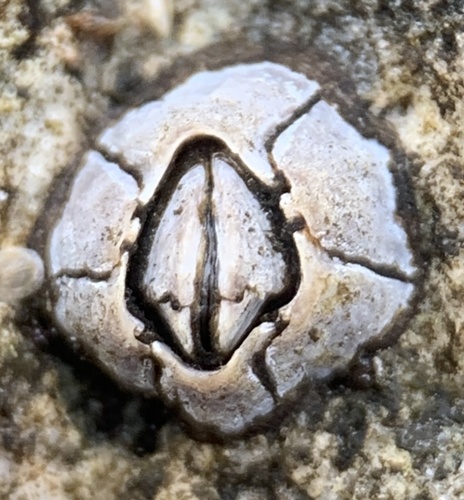
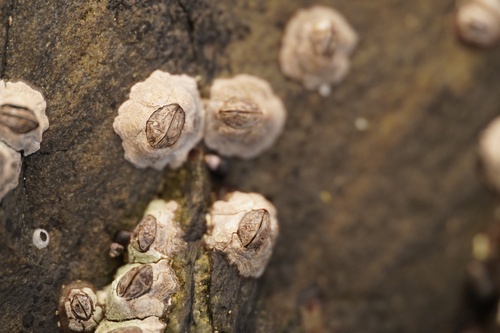
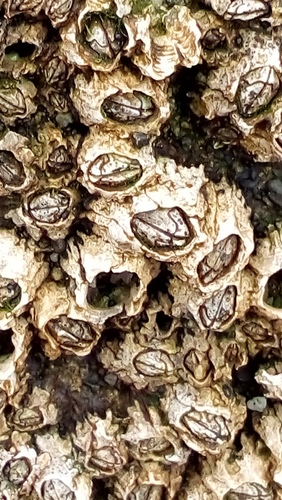
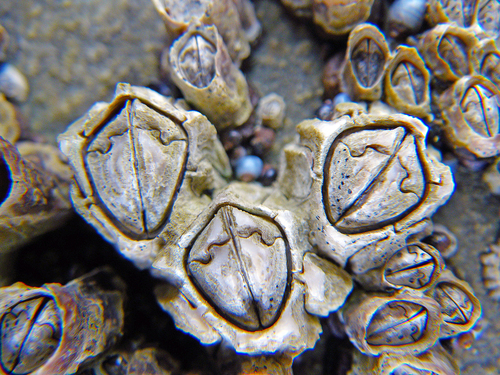
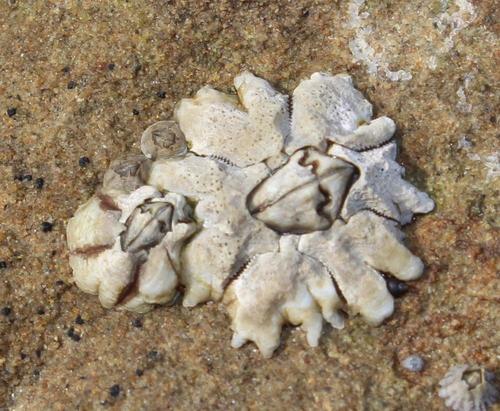
Adult shells of Chamaesipho columna are very small. Solitary specimens have a maximum rostrocarinal diameter of 9 mm, while individuals growing in columnar form have a rostrocarinal diameter of up to 4 mm. Crowded individuals can reach a shell height of 16 mm, compared to a maximum height of 6 mm in solitary specimens. The shell is whitish, and develops pitting as it erodes. Juveniles have a shell wall made of 6 plates, which fuses into 4 plates once the shell reaches 0.5 mm in diameter. Sutures between the plates fuse completely, and cannot be seen in adults even after acid etching. The basis of the shell is membranous. Opercular plates are deeply interlocked with a sinuous articulation, and experience substantial environmental wear that creates large variations in individual shape and appearance. This articulation is far less deep than that of Chamaesipho brunnea. The interior of the scutum has a wide, shallow adductor pit and a small lateral depressor pit. It has a distinct, low rounded scutal adductor ridge, which contrasts with C. brunnea, where this ridge is at best poorly developed. The scutal articular ridge, which forms a large central lobe on the tergal margin in chthamaloids, is rounded in C. columna; in C. brunnea this lobe is very large and rectangular. The tergum of C. columna is much narrower than that of C. brunnea, and its articular margin has two shallow, relatively rounded re-entrants, while C. brunnea has a single very deep re-entrant. Tergal depressor crests are prominent in both species, but C. columna has fewer, with approximately up to four crests compared to up to seven in C. brunnea. These crests are not visible from the exterior in C. columna. Neither species has a tergal spur. Moore (1944) provides full descriptions of both hard and soft-part anatomy for juvenile and adult stages of C. columna. In terms of distribution and habitat, C. columna occurs in all New Zealand waters except the Chatham Islands. Most of its range overlaps with the range of C. brunnea. In overlapping areas, C. columna is found below the intertidal zone occupied by C. brunnea, which lives higher in the intertidal. C. columna also colonizes areas that are more protected from direct wave action, while C. brunnea prefers the highest intertidal areas that are most exposed to wave action. Both species strongly prefer rocky or shell substrates, and rarely grow on wood. Unlike almost all other chthamaloids, C. columna occasionally enters tidal estuaries, but does not go far enough to encounter brackish or muddy water.