About Chamaesipho brunnea Moore, 1944
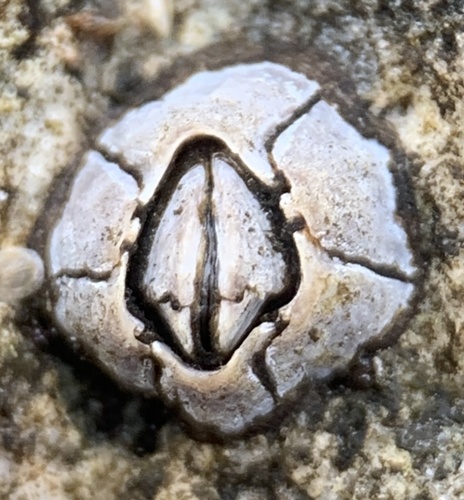
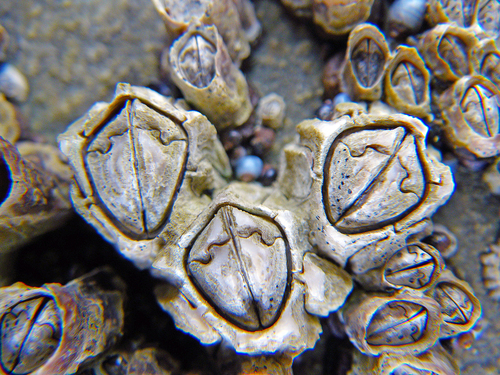
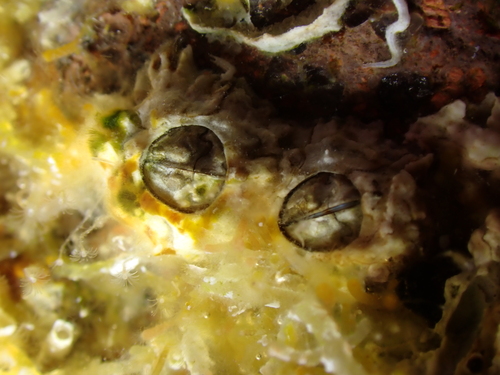
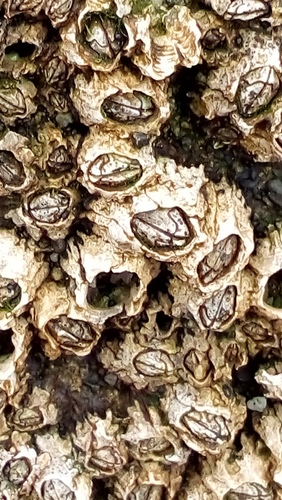
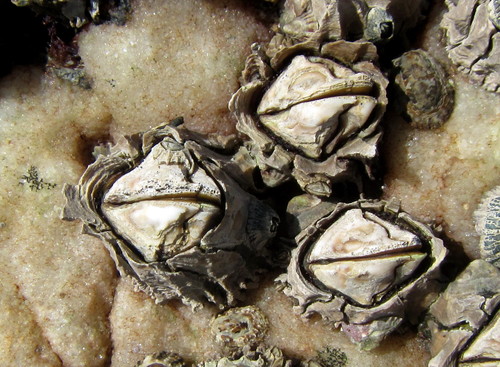
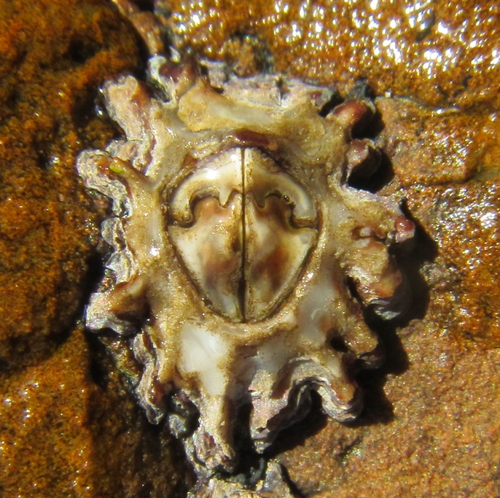
Chamaesipho brunnea Moore, 1944 is a common intertidal barnacle native to New Zealand, occurring on both the North Island and South Island. Juvenile individuals of this species have six shell wall plates, which reduce to four when the barnacle reaches adulthood. As individuals age, all of their shell plates become fully concrescent, leaving no trace of sutures on either the interior or exterior of the shell. The shell of this species is brown in color. The related and sometimes co-occurring species Chamaesipho columna is nearly half the size of Chamaesipho brunnea. Elminius, another barnacle genus that can occur alongside both Chamaesipho species, also has four shell wall plates, but its plates remain distinct through all life stages. The shell of C. columna corrodes into a pitted surface, while C. brunnea’s shell develops lamellar corrosion when it corrodes. This is an intertidal species that prefers exposed, high-energy locations, ranging from the upper surf zone above the high tide mark down to neap tide level. Populations of C. brunnea grow less dense in less agitated water conditions. Where the range of C. brunnea overlaps with that of Chamaesipho columna, C. brunnea is always found in a zone above that occupied by C. columna. In more protected areas, C. columna becomes the dominant species. Chamaesipho brunnea occurs naturally only on the shores of New Zealand, and its range overlaps extensively with that of C. columna. It colonizes all North Island coasts that match its preferred environmental conditions. On the South Island, it is not found on Stewart Island or in areas south of Stewart Island. Only C. brunnea is present on the Chatham Islands. This species breeds primarily during spring and summer, so water temperature may be a controlling factor for its overall distribution.