About Chamaepetes goudotii (R.Lesson, 1828)
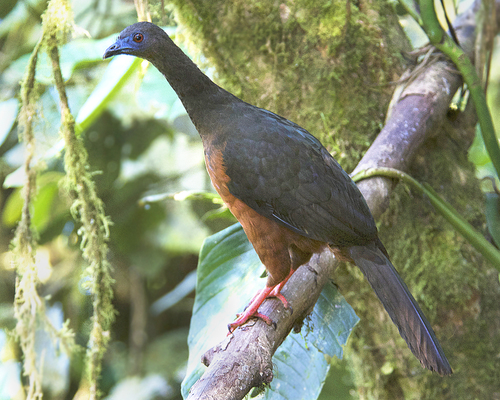
The sickle-winged guan (Chamaepetes goudotii) measures 50 to 65 cm (1.64 to 2.13 ft) long and weighs 550 to 800 g (1.21 to 1.76 lb). Subspecies differ in size, with C. g. tschudii and C. g. rufiventris being the largest. Adults of the nominate subspecies have a brown head and neck, dark upperparts, a bright chestnut belly, pale blue facial skin, and red eyes. Juveniles have a similar appearance but are duller in color. C. g. sanctaemarthae has redder upper breast, throat, and cheeks than the nominate subspecies, and a darker red vent area. C. g. fagani has much darker head and upperparts than both the nominate and C. g. sanctaemarthae, with chestnut underparts. C. g. tschudii is similar to C. g. fagani, but has more olive-brown upperparts and paler chestnut underparts. C. g. rufiventris has gray edges on its neck feathers that create a scaly appearance; it also has paler olive upperparts and less chestnut on the underparts than C. g. tschudii. Each subspecies of sickle-winged guan has a distinct distribution. C. g. goudotii is found in the western and central Andes of Colombia, extending south to Nariño Department. C. g. sanctaemarthae occurs in the Sierra Nevada de Santa Marta of northeastern Colombia. C. g. fagani lives along the west slope of the Andes from Colombia's Nariño Department south to Ecuador's El Oro Province. C. g. tschudii ranges along the east slope of the Andes from southern Colombia through Ecuador to Peru's Department of San Martín. C. g. rufiventris is found along the east slope of the Andes from central to southern Peru, and in isolated areas of northern and central Bolivia. The sickle-winged guan inhabits humid and wet forest. It prefers tall forest, but can also be found at forest edges and in secondary forest. It generally occupies middle elevations. It reaches elevations as high as 3,000 m (9,800 ft) in the Sierra Nevada de Santa Marta, but is mostly found between 1,100 and 2,500 m (3,600 and 8,200 ft) elsewhere in Colombia. In Peru, it typically occurs between 1,450 and 2,500 m (4,760 and 8,200 ft). Its populations in Bolivia live at the highest elevations of the species' range, between 2,500 and 3,500 m (8,200 and 11,500 ft).