About Chamaenerion angustifolium (L.) Scop.
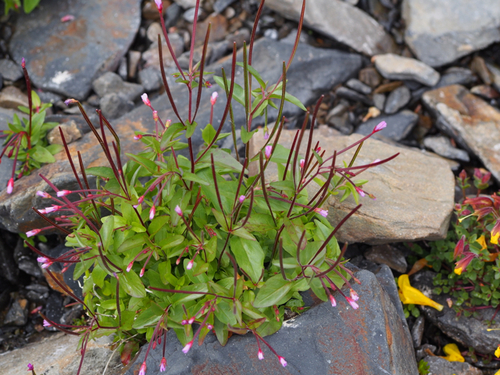
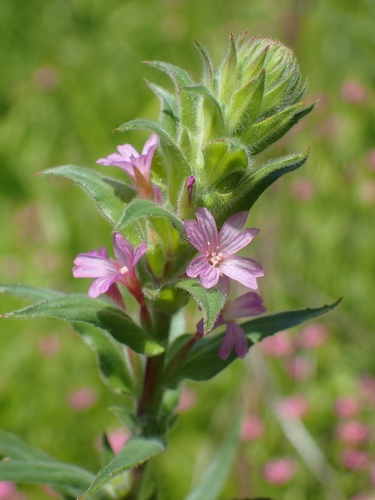
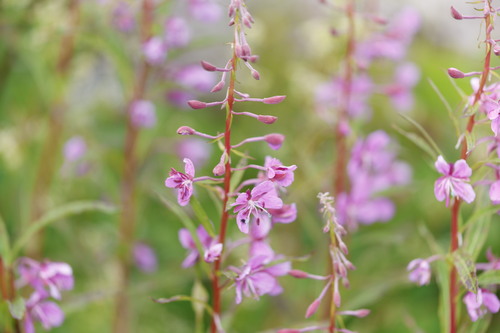
Chamaenerion angustifolium (L.) Scop. is a herbaceous perennial plant that is commonly called fireweed. It has reddish, usually simple, erect, smooth stems that grow 0.5–2 metres (1+1⁄2–6+1⁄2 feet) high, with scattered alternate leaves. Its leaves are spirally arranged, entire, narrowly lanceolate, and pinnately veined; secondary leaf veins anastomose, joining to form a continuous marginal vein just inside the leaf edges. The inflorescence is a symmetrical terminal raceme that blooms progressively from bottom to top, creating a gracefully tapered shape. Flowers measure 2 to 3 centimetres (3⁄4 to 1+1⁄4 inches) in diameter and are slightly asymmetrical, with four magenta to pink petals and four narrower pink sepals behind the petals. The protruding style has four stigmas, and the floral formula is ✶/↓ K4 C4 A4+4 or 4+0 Ğ(4). The upright, reddish-brown linear seed capsule splits from the apex and curls open. Each capsule holds 300 to 400 minute brown seeds, with a total of roughly 80,000 seeds per plant. Seeds have silky hairs that aid wind dispersal, allowing them to spread very easily; this species often becomes a weed and dominant species on disturbed ground. Once established, plants also spread extensively through underground roots, with a single individual eventually forming a large patch. This plant occurs throughout the northern hemisphere, between latitudes 30° and 68°, and is most common in temperate climates. It is confirmed to be present in the Pannonian macroregion via herbarium specimens. Fireweed is often abundant in wet calcareous to slightly acidic soils in open fields, pastures, and particularly burned-over lands. It is a pioneer species that quickly colonizes open, low-competition areas such as forest fire sites and forest clearings. It grows and flowers as long as open space and abundant light are available. Fireweed reaches its average peak colonization after five years, then begins to be replaced as trees and brush grow larger. When a new fire or other disturbance opens the ground to light again, its seeds germinate. Some areas with heavy seed counts in soil can become covered in pure dense stands of this species after burning, and flowering turns the landscape into colored fields. Fireweed is an effective colonizer, and may not appear until after a fire has moved through the landscape. Its very high dispersal capacity means propagule pressure from its regional presence lets it quickly colonize a disturbed area. Once seedlings establish, the plant reproduces quickly and covers the disturbed area via seeds and rhizomes. It is somewhat adapted to fire, and can prevent fire from reoccurring in the landscape. It is also well adapted to seed in severely burned areas, because exposed mineral soil left after organic soil layers are removed provides a good seedbed. In 18th century Britain, the plant was considered a rare species confined to a small number of locations with damp, gravelly soils, and was misidentified as great hairy willowherb in contemporary floras. Its shift from local rarity to widespread abundance happened at the same time as the expansion of the railway network and associated soil disturbance. It became locally known as 'bombweed' for its rapid colonization of bomb craters during World War II. Bears and elk are known to favor this plant as food. Fireweed flowers follow a generalised pollination syndrome, and are visited by a wide variety of insects. Some species in the insect order Lepidoptera frequently use this willowherb as their primary larval host-plant; examples include the elephant hawk moth (Deilephila elpenor), bedstraw hawk moth (Hyles gallii), and the white-lined sphinx moth (Hyles lineata). The plant is not considered palatable, but its young shoots and leaves can be cooked and eaten. Fresh leaves can be eaten raw. Young flowers are also edible, and are made into jelly in the Yukon. Stems of older plants can be split to extract edible raw pith. Roots can be roasted after scraping off the outer layer, but often taste bitter; to reduce bitterness, roots are collected before the plant flowers, and the brown thread in the middle is removed. Stem centers can also be prepared by splitting the outer stalk, and eaten raw. Traditionally, young shoots are collected in spring by Native American and Siberian people and mixed with other greens. As the plant matures, leaves become tough and somewhat bitter. Fireweed petals are made into jelly, and mature leaves are dried for use as tea. Siberian Native people traditionally eat roots raw. When properly prepared soon after picking, fireweed is a good source of vitamin C and provitamin A. The Denaʼina add fireweed to their dogs' food. Fireweed is also used medicinally by the Upper Inlet Dena'ina, who treat pus-filled boils or cuts by placing a piece of the raw stem on the affected area; this is said to draw pus out of the cut or boil and prevents a pus-filled cut from healing over too quickly. Leaves can be used to make tea. In Russia, fireweed is made into a tea known as Ivan-Chai (Ivan-Tea) or Koporsky tea, named after the town of Koporye where it has been produced since the 13th century. Russians also use it as a highly prized medicinal herb. The popularity of fireweed tea likely stems from its production being similar to that of common black tea (Camellia sinensis), resulting in a richly flavoured, deeply coloured herbal tea that contains no caffeine. It is sold commercially in blends with mint or thyme. Fireweed tea is high in iron, copper, potassium and calcium. Honey produced from fireweed is highly valued for its quality. Most fireweed honey is produced in cool climate locations, such as the Pacific Northwest in the United States and Scandinavian countries in Europe. Fireweed's natural variation in ploidy has led to its use in scientific studies of the possible effects of polyploidy on adaptive potential and species diversification. Because fireweed can colonize disturbed sites, even areas affected by old oil spills, it is often used to re-establish vegetation. It is also grown as an ornamental plant. A white-flowered form, C. angustifolium 'Album', is listed by the Royal Horticultural Society.