About Chamaelirium luteum (L.) A.Gray
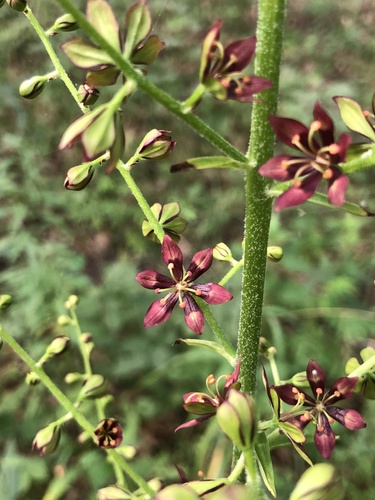
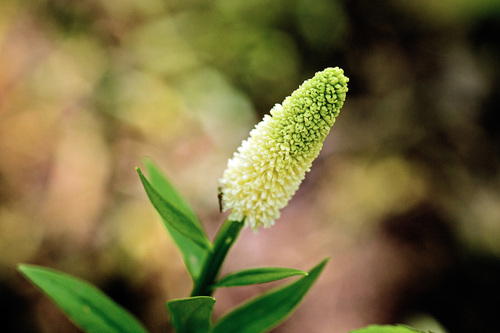
Chamaelirium is a genus of flowering plants that contains only one species: Chamaelirium luteum (L.) A.Gray. This species has several common names: blazing-star, devil's bit, false unicorn, fairy wand, and helonias. It is a perennial herb native to eastern North America. It grows in a variety of habitats, including wet meadows and deciduous woodlands. Chamaelirium luteum produces a basal rosette of around six leaves, each 8–15 cm long. A single spike-like raceme inflorescence emerges from the rosette, measuring 1–1.5 cm in diameter and 8–30 cm in length. This species is generally dioecious, and most wild populations have male-biased gender ratios. This bias occurs because female plants have higher mortality rates and tend to flower less frequently than male plants. Female flowering stalks are typically taller, reaching a maximum total plant height of about 1.2 m, but they produce roughly ten times fewer flowers than male stalks. As the only member of its monotypic genus, Chamaelirium luteum is quite rare at the edges of its native range. This species occurs in temperate eastern North America, in regions east of the Mississippi River in the United States, and historically has been recorded from southern Ontario, Canada. Because the herb is usually harvested from wild populations, Chamaelirium luteum is at risk of extinction. Cultivation methods for this species are still under development to meet existing market demand. Chamaelirium luteum is grown as an ornamental plant and used as a medicinal herb. Historically, it was widely used by Indigenous peoples. It was traditionally employed to prevent miscarriages, and has a reputation for improving fertility. Today, it is used to treat menstrual problems, pregnancy-related complaints, fertility issues, and ovarian cysts, and is also used as a diuretic. Rhizomes of Chamaelirium luteum are ready for harvest six years after growth. Harvest takes place in fall, after mature seeds have been collected. After harvesting, soil and roots from other plants are removed from the rhizomes, which are stored unwashed until further processing. During storage, rhizomes must be protected from both complete drying out and excess moisture, which can cause mold growth. Rhizomes are washed carefully just before further processing.