About Chamaeleo calyptratus Duméril & Duméril, 1851
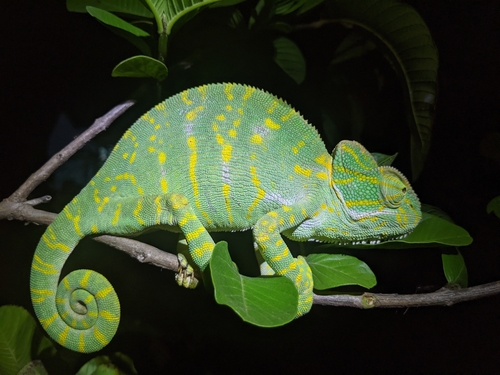
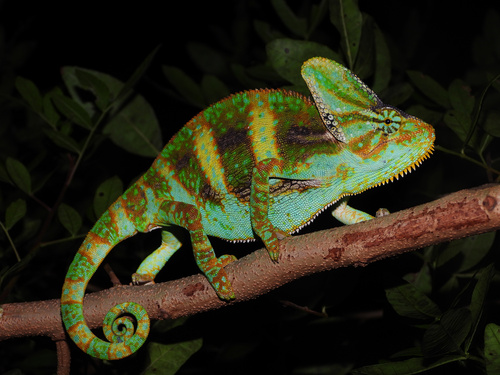
Adult male veiled chameleons (Chamaeleo calyptratus) measure 43 to 61 cm (17 to 24 in) from snout to tail tip, while adult females are shorter, reaching no more than about 35 cm (14 in), and have thicker bodies. Both sexes have a casque (a raised bony structure) on the head that grows larger as the chameleon matures, reaching up to about 5 cm (2.0 in) in the largest adults. Newly hatched veiled chameleons are pastel green, and develop stripes and varied coloration as they mature. Adult females are green with white, orange, yellow, or tan mottling. Adult males have brighter coloration with more defined bands of yellow or blue, plus some mottling. Multiple factors can affect this species' coloration, including social status. In experimental conditions, young veiled chameleons raised in isolation developed darker, duller coloration than those raised with other individuals. Females change color over the course of their reproductive cycles, and veiled chameleons also typically shift to a much darker color when stressed. The veiled chameleon is an arboreal species native to the south-western Arabian Peninsula, where it inhabits a semi-arid tropical climate. It occupies multiple habitat types in its native range, including plateaus, mountains, and valleys, and lives in trees and other large plants. It prefers warm temperatures, generally between 24 and 35 °C (75 and 95 °F). This species is highly susceptible to stress, which makes it difficult to treat in captivity. Veiled chameleons reach sexual maturity at four to five months old, and can breed multiple times per year. Females lay large clutches of up to 85 tough, white eggs, which they bury in sand. Embryos enter a dormant state called diapause that typically lasts 60 to 75 days within the egg before development begins, and rising substrate temperatures initiate this development. A 2004 study found that while veiled chameleon embryonic development usually starts at fertilization and continues until hatching, development sometimes stalls at the gastrula stage for months after eggs are laid. The study's researchers found that moisture levels have little to no effect on this delay, but temperature plays a determining role in development time: an increase in ambient temperature initiates development of diapausing embryos. Juvenile veiled chameleons can increase their body mass by up to two orders of magnitude within one year after hatching. Their feeding structures (mouth, snout, tongue, jaw) grow rapidly while remaining functional, so the musculoskeletal system of these feeding structures grows with negative allometry relative to snout-vent length (SVL). Studies of captured veiled chameleons show that jaw movement velocity is typically greater in adults than in juveniles, which indicates a shift in energy storage and tongue projection release mechanisms between the juvenile and adult life stages. Unlike many other reptiles, veiled chameleon sex ratios are not affected by incubation temperature. Even when accounting for differential mortality, any sex ratio bias is negligible. Anecdotal claims of temperature-dependent sex ratios in this species came from reporting and statistical errors. Veiled chameleons have a naturally short lifespan: even with good care, they typically only live 6 to 8 years, and males usually live longer than females.