About Chamaecyparis lawsoniana (A.Murray bis) Parl.
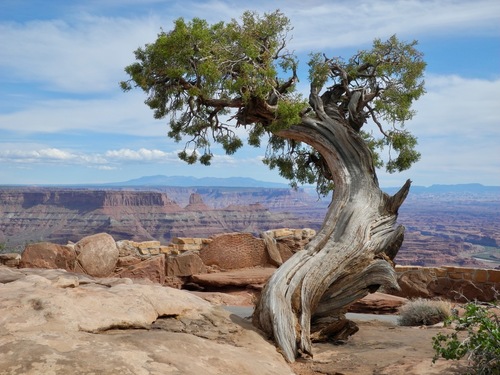
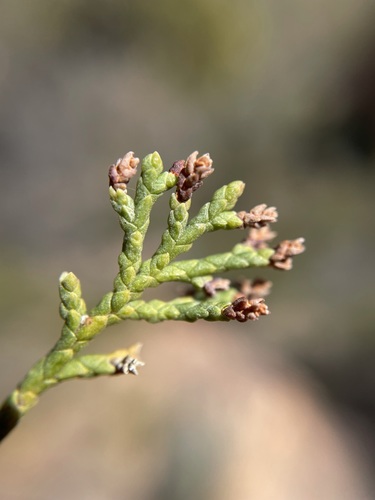
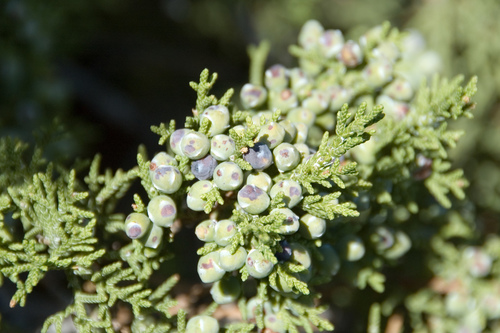
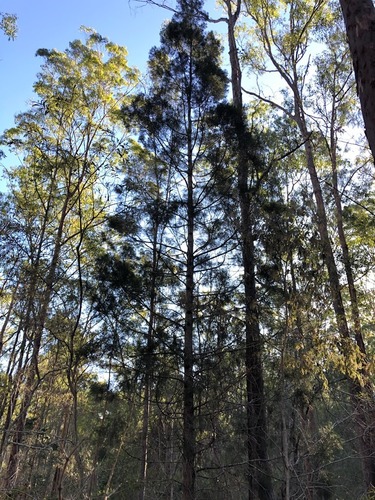
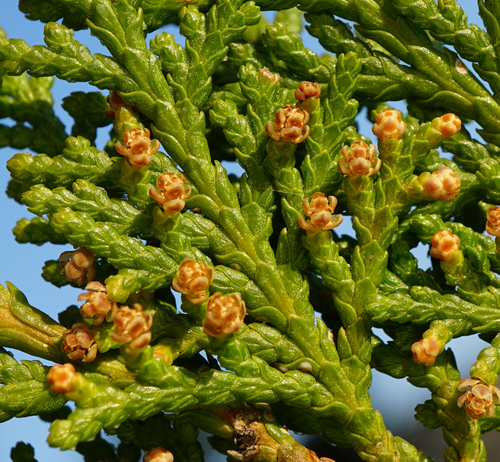
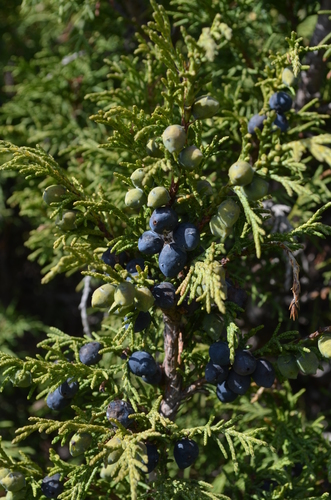
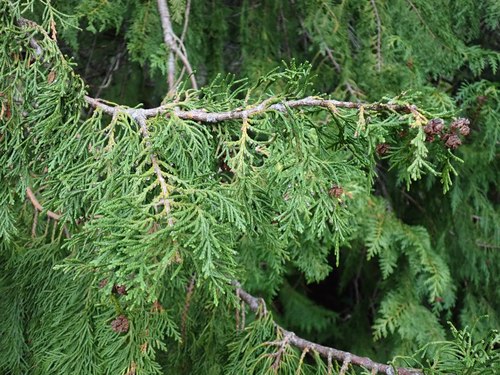
Chamaecyparis lawsoniana (A.Murray bis) Parl. is a large evergreen tree. Mature specimens typically grow up to 50 m (160 ft) or taller, reaching an exceptional maximum height of 81 m (266 ft). Trunks usually measure 1.2–2 m (4–7 ft) in diameter, with exceptional specimens reaching 3.65 m (12.0 ft). The silver-brown bark is vertically furrowed, and measures 15–25 centimetres (6–10 in) thick near the trunk base. Foliage grows in lacy, flat sprays that have a feathery appearance, and is usually a somewhat glaucous blue-green color. Leaves are scale-like, 3–5 millimetres (1⁄8–3⁄16 in) long, with narrow white markings on the underside, and grow on slightly flattened shoots. Foliage gives off a rather pungent scent similar to parsley. Seed cones are globose, 7–14 millimetres (9⁄32–9⁄16 in) in diameter, with 6–10 scales; they start green, mature to brown in early fall, 6–8 months after pollination. Male cones are 3–4 millimetres (1⁄8–5⁄32 in) long, dark red, and turn brown after releasing pollen in early spring. The seeds fall quickly and are able to float on water. Old specimens have no lower branches near the trunk base and often have dead tops, and can live up to approximately 600 years. This species is native to southwestern Oregon and northwestern California. It grows from sea level up to 1,500 metres (4,900 ft) in the valleys of the Klamath Mountains, and is often found growing along streams. It grows best at the northern end of its native range. The thick bark of Chamaecyparis lawsoniana gives it resistance to wildfires. The species regenerates well on disturbed land across a variety of soils, but requires consistent moisture. It is shade tolerant, though less shade tolerant than its common competitors western hemlock and white fir. The old-growth population near Coos Bay, Oregon, was eliminated by logging and wildfires in 1867–1868, and then again by fire and root disease in 1936. In cultivation, Chamaecyparis lawsoniana grows best in well-drained but moist soil, in a fairly sheltered position with full sun. Several hundred named cultivars, selected for varied crown shapes, growth rates and foliage colors, are planted in parks and gardens. In the United Kingdom, a number of these cultivars have earned the Royal Horticultural Society's Award of Garden Merit, confirmed in 2017. Euro-Americans first documented this species in the 1850s. Its wood is lightweight while having high strength and rot resistance, even after long exposure to salt water. The wood's properties are similar to those of yellow-cedar, but historically it was more readily available in the Pacific Northwest region of North America. On shorelines without docks, logs were transported directly onto ship decks via high-line cable. The wood was valued for boatbuilding. The species was an important part of Oregon's lumber industry until the 1950s, when the industry was crippled by disease. The wood was preferred for storage battery cell separation, Venetian blinds, and other applications. Eventually, quality specimens were almost exclusively shipped to East Asia, where the wood is highly valued. Large quantities have been exported to Japan for use in making coffins, shrines, and temples. Its lumber is known for a strong fragrant ginger aroma, produced by an oil that resists decay and repels insects including termites; this oil has been used as an insecticide. Due to its straight grain, it is also one of the preferred woods for manufacturing arrow shafts. It is considered an acceptable, though not ideal, wood for aircraft construction. It is also considered more than acceptable for use in stringed instruments; its fine grain, good strength, and tonal quality are highly regarded for guitar soundboards.