About Chamaecrista rotundifolia (Pers.) Greene
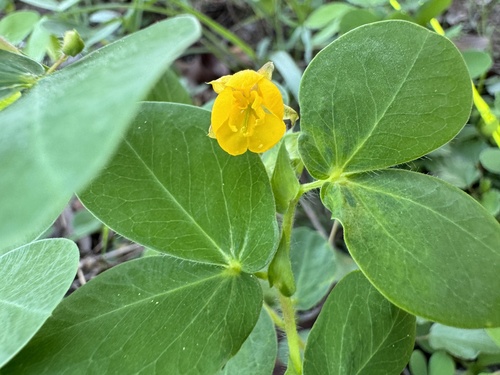
Round-leaf cassia, Chamaecrista rotundifolia, is a fast-spreading perennial forage legume. It has a sub-woody, semi-erect stem covered in small hairs, reaching up to 1 metre in height, and grows a shallow taproot. Key identifying features include small axillary yellow flowers, which appear depending on the season, and the characteristic round bifoliolate leaves that give the species its common name. It grows primarily during the summer, but remains active through spring and autumn, and has two separate flowering seasons: one in spring, and one in summer. The species is self-fertilizing, and produces a large amount of seed via natural reseeding. The species originated in North America (Mexico), Mesoamerica (Costa Rica, Honduras, Panama), the Caribbean (Cuba, Jamaica, Puerto Rico), and Tropical South America (Argentina, Bolivia, Brazil, Colombia, Ecuador, Guyana, Paraguay, Uruguay, Venezuela). It has since become naturalized in many other regions, and is currently found in the Southeast United States, West Africa, and Australia, and shows promise in countries including China and Nigeria. Round-leaf cassia can be used for open grazing, as well as for hay and silage. It has a high dry matter content, and provides key nutrients for livestock, including protein, fibre, energy, and vitamins. It can be cut and transported to tethered or penned livestock, or grazed in place for a few hours each day. When feed sources are limited, it works as a high-quality supplement for lower-quality feeds such as crop residues and native pasture plants. Including round-leaf cassia in cattle feed can support healthy weight gain in cattle. It should be noted that it is not suitable for feeding to horses. As a nitrogen-fixing plant, round-leaf cassia also acts as a green fertilizer, and can increase crop yields either directly by improving soil fertility, or indirectly when higher-quality manure from livestock that have eaten the legume is added to farmland. It can be used in a range of agricultural settings: in pastures, fodder banks, and on fallow land to replace existing plant species, as well as grown alongside fruit trees or intercropped in rows with cereal crops. These uses support no-till agriculture, which has been shown in many cases to contribute to better, more sustainable farming. As a cover crop, it also offers benefits for weed and pest management.