About Chamaea fasciata (Gambel, 1845)
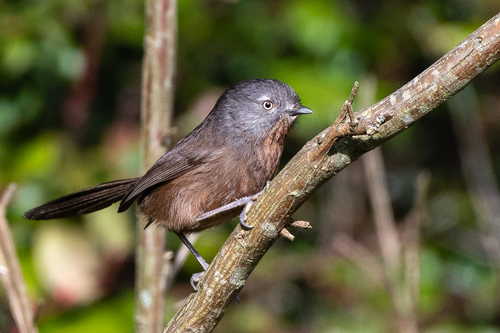
The wrentit, Chamaea fasciata, is a small bird measuring 15 cm (5.9 in) long. It has uniform dull olive, brown, or grayish plumage, short wings, a long tail that is often held high (which is why it is compared to wrens), a short bill, and a pale iris. Because of its retiring nature and loud voice, the wrentit is more likely to be detected by its call than by sight. Its distinct call sounds similar to a ping-pong ball falling onto a table. The wrentit is a non-migratory, sedentary resident that lives in a narrow strip of coastal habitat along the western coast of North America. Its range extends from Oregon south through California to Baja California, the northern state of the Baja California peninsula. It is usually restricted to specific chaparral and woodland habitats, and nests in shrubs around 1 metre (3 ft) high, such as poison oak (Toxicodendron diversilobum), coyote bush (Baccharis pilularis), and California blackberry (Rubus ursinus). Logging and other habitat changes have allowed this species to expand its range recently, especially northward. Wrentits mate for life, and form pair bonds just a few months after hatching. Both males and females sing; the faster rhythm of the male’s song is one of the only ways to tell the two sexes apart. Both sexes defend their territory year-round, and both take part in building the nest. Nest construction is a four-stage process that takes around two weeks. Both sexes also incubate the clutch of three or four eggs for 14 days. Chicks fledge 15 days after hatching, and at this stage they are unable to fly. They continue to be fed by their parents for an additional 40 days after fledging. The wrentit feeds by moving quietly through dense scrub, gleaning exposed insects that it locates by sight. It feeds primarily on beetles, caterpillars, bugs, and ants, but will also eat small berries and seeds.