About Chalcostigma stanleyi (Bourcier, 1851)
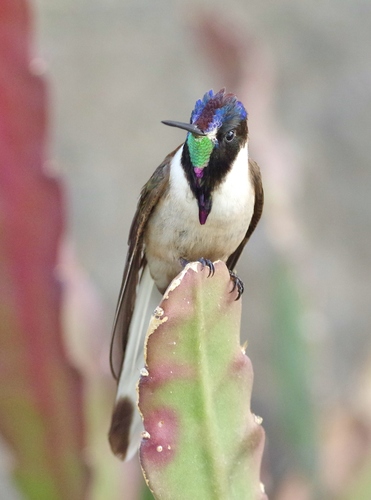
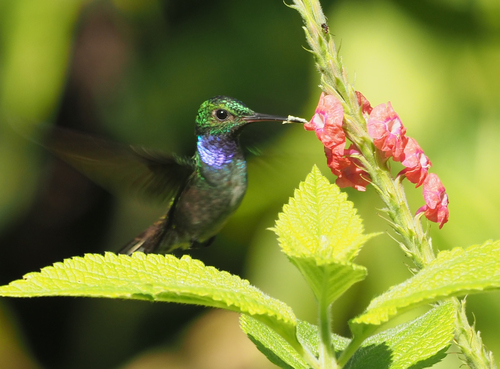
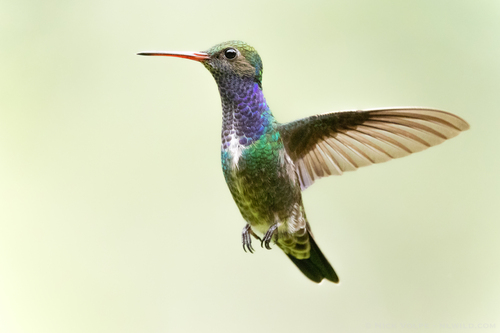
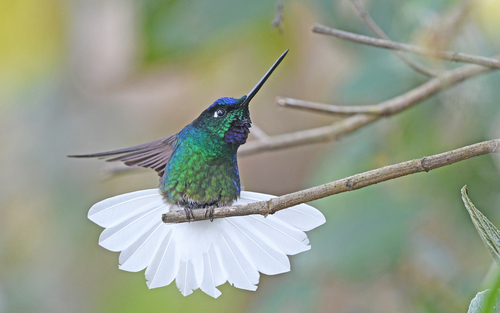
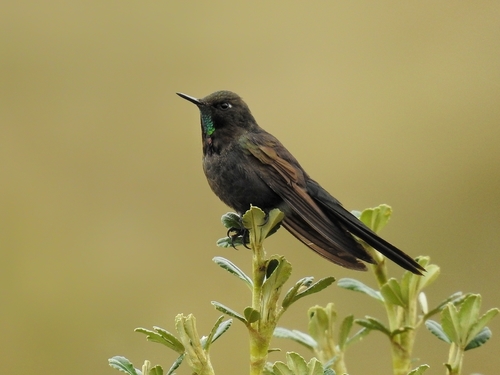
The blue-mantled thornbill (Chalcostigma stanleyi) measures 12 to 13 cm (4.7 to 5.1 in) in length. Males weigh approximately 6.2 g (0.22 oz), while females weigh 4.5 g (0.16 oz). Both sexes have a short straight black bill and a small white spot behind the eye. Adult males of the nominate subspecies are mostly dark sooty brown, with a bronzy green sheen on the crown and nape, violet-blue iridescence on the back, and turquoise uppertail coverts. Their forked tail is steel blue, and they have a narrow gorget that is emerald green on the chin, transitioning through pink to purple-violet or violet-blue at the lower edge. Adult females are similar in appearance to males, but only the chin area of their gorget is green, and their outer tail feathers have pale tips. Juveniles look similar to adult females. The entire upperparts of subspecies C. s. versigulare reflect deep violet-blue, rather than only the back, and the lower pink to violet section of its gorget is narrower than that of the nominate subspecies. C. s. vulcani is similar to C. s. versigulare, but the lower portion of its gorget is blue-gray or gray-violet. The nominate subspecies occurs on both slopes of the Ecuadorian Andes, between the departments of Carchi and Azauy. C. s. versigulare is found on the east slope of the Peruvian Andes from east of the Marañón River south to the Cordillera Carpish in Huánuco Department, and also on the west slope in the Cordillera Blanca. C. s. vulcani lives on the eastern Andean slope from southern Peru to Cochabamba Department in central Bolivia. This species inhabits steep, rocky slopes with moderately humid páramo grasslands and jalca vegetation, and it prefers patches of Polylepis and Gynoxys woodland within these landscapes. It generally occurs at elevations between 3,000 and 4,200 m (9,800 and 13,800 ft), but has been recorded as low as 2,200 m (7,200 ft) and as high as 4,500 m (14,800 ft).