About Chalcophaps longirostris Gould, 1848
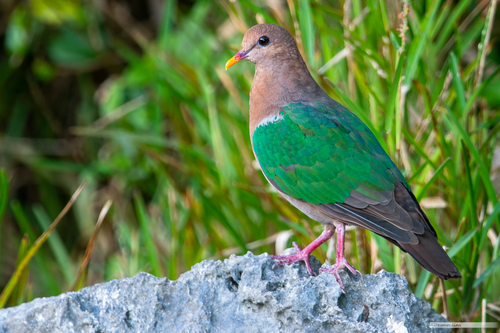
Chalcophaps longirostris Gould, 1848, commonly known as the Pacific emerald dove, is a stocky, medium-sized pigeon that typically measures 23 to 28 centimetres (9.1 to 11.0 inches) in length. This species is common in rainforests, similar dense wet woodlands, farms, gardens, mangroves, and coastal heaths. Its back and wings are bright emerald green; flight feathers and tail are blackish, and broad black and white bars appear on the lower back when the bird is in flight. The head and underparts are dark vinous pink, fading to greyish on the lower belly. Eyes are dark brown, the bill is bright red, and legs and feet are rufous. Males have a white patch on the edge of the shoulders and a grey crown, which females lack. Females generally have a browner overall complexion with a grey mark on the shoulder. Immature birds resemble females, but have brown scallops on their body and wing plumage. In flight, this species exposes a buff underwing and chestnut-coloured flight feathers. Pacific emerald doves usually occur singly, in pairs, or in small groups. They are quite terrestrial, often searching for fallen fruit on the ground, and spend little time in trees except when roosting. They eat seeds and fruits from a wide variety of plants, and are generally tame and approachable. This tame behavior makes them vulnerable to mesopredators such as feral cats; the bird's largest predator is the cassowary, which also inhabits the island of New Guinea and north-east Australia. The species builds a scant stick nest in a tree up to five metres high, and lays two cream-coloured eggs. In Australia, breeding typically occurs in spring or early summer in southeastern Australia, and late in the dry season in northern Australia. Its flight is fast and direct, with the regular wing beats and occasional sharp wing flick that are characteristic of pigeons in general. It often flies low between the patches of dense forest it prefers, but will frequently walk away rather than fly when disturbed. It is particularly adept at weaving between trees when flying through forests. Its call is a low soft moaning cooing that consists of about six to seven coos, starting quietly and increasing in volume. It also produces a nasal "hoo-hoo-hoon" call. Males perform a bobbing dance during courtship.