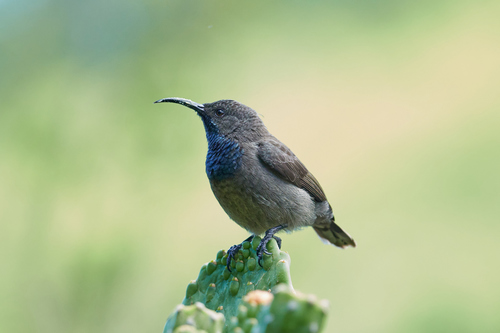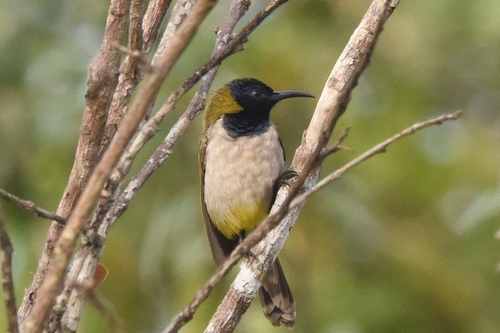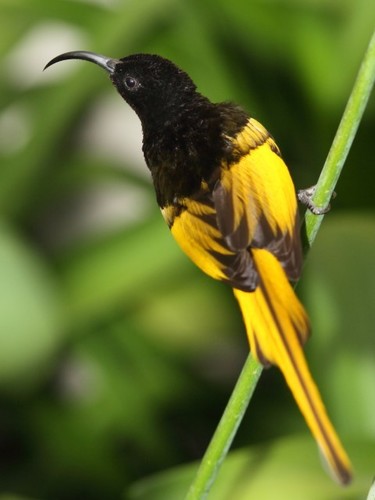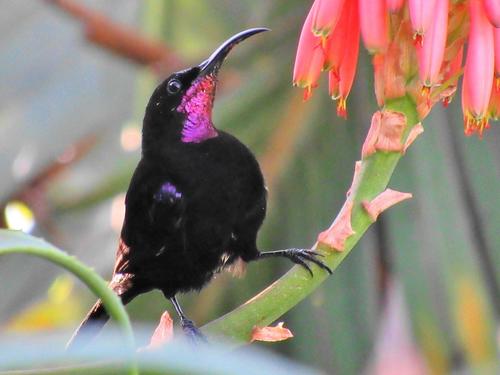
About Chalcomitra amethystina (Shaw, 1812)
The amethyst sunbird, also known as the black sunbird, has the scientific name Chalcomitra amethystina (Shaw, 1812). It is a species of passerine bird belonging to the family Nectariniidae. This bird is native to the Afrotropics, and is found mostly south of the equator. It is commonly found in well-watered habitats, and makes seasonal movements to visit flowering woodlands. Local population declines have occurred due to the loss of some woodlands, but its range has also expanded alongside the spread of wooded gardens. Amethyst sunbirds are widespread permanent residents in woodland, mesic savanna, forest edge, and suburban gardens. They only occur sparsely in dry savanna or low dry regions, where they remain restricted to riparian woods or groups of nectar-bearing plants, and are distinctly scarce in the Limpopo valley and mopane regions. A noticeable influx of amethyst sunbirds occurs in summer in the Zambezi valley and Great Zimbabwe woodlands. They are strictly summer visitors, present from September or October to April, in Kalahari sand (or Gusu) woodlands, where they reach high densities when Baikiaea trees are flowering. On seaward-facing slopes, they are very common permanent residents up to an elevation of 1,800 metres, with high reporting rates in afromontane forest and valley bushveld. This species has been recorded in Angola, Botswana, Burundi, Republic of the Congo, Democratic Republic of the Congo, Eswatini, Ethiopia, Gabon, Kenya, Malawi, Mozambique, Namibia, Somalia, South Africa, South Sudan, Tanzania, Uganda, Zambia, and Zimbabwe.