About Chalcolestes viridis (Vander Linden, 1825)
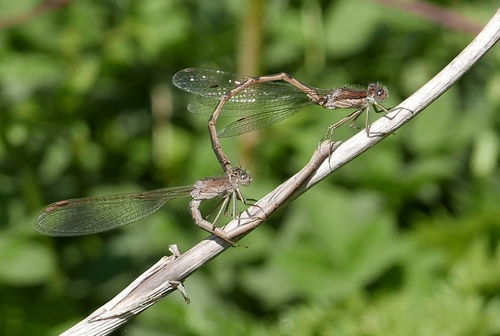
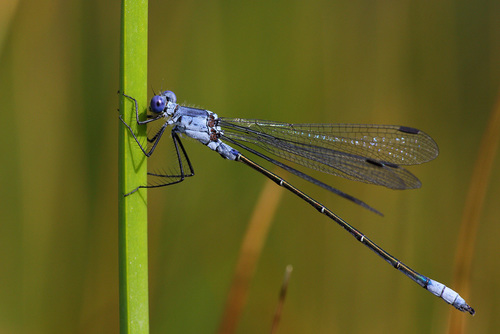
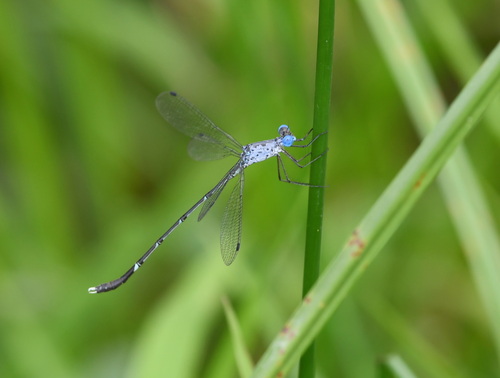
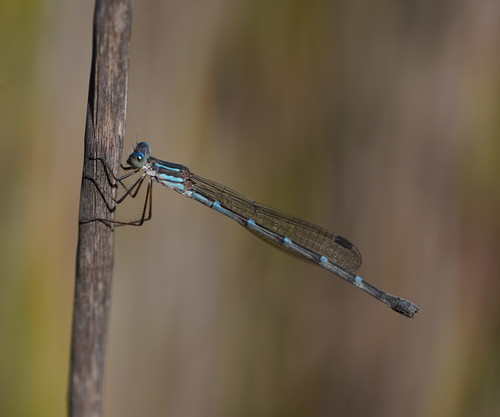
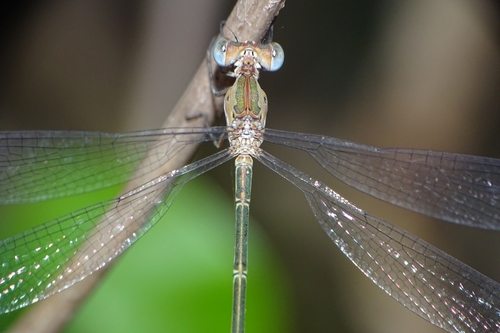
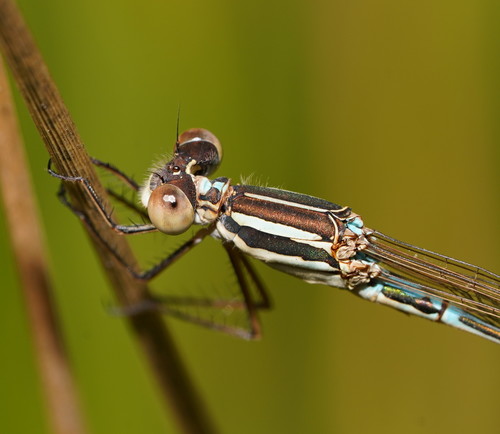
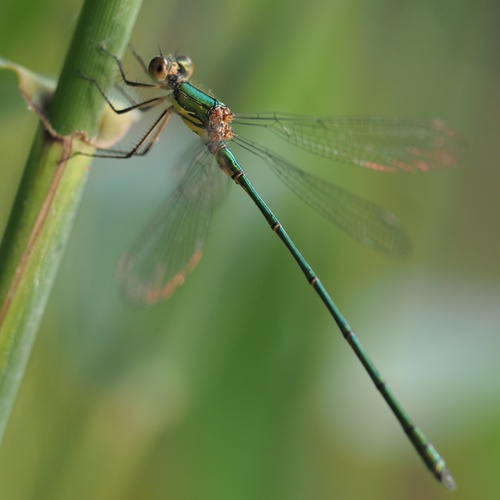
Field identification: It is not possible to reliably distinguish Chalcolestes viridis from C. parvidens in the field. Like other Lestes damselflies, both species are primarily metallic green, but they are larger and darker than other Lestes, and lack the powder blue pruinescence common in other members of the genus. Their pterostigma is pale brown and outlined in black. The thorax has thin yellow antehumeral areas, with a broader yellow stripe positioned above a thin black line on each side; the upper edge of this stripe is irregular. Both C. viridis and C. parvidens have a prominent spur-like marking on the side of the thorax. For males, the abdomen is very long. The lower anal appendages are less than half the length of the upper anal appendages, which are a distinctive pale yellow with black tips. For females, the ovipositor is longer than that of Lestes dryas. Distribution and habitat: C. viridis occurs across southern and central Europe and North Africa. In the eastern Mediterranean, it is replaced by C. parvidens, with overlapping ranges in Italy and the Balkans. C. viridis is found on many Mediterranean islands including Corsica, Sicily, Mallorca, Menorca, and Ibiza, as well as in the Maghreb region of North Africa, Turkey, and the Middle East. Many older records of C. viridis from the eastern part of its range may actually refer to C. parvidens. It lives in still or slow-flowing water bodies including ditches, ponds, lakes, and canals, with overhanging willows, alders, or birches that are used for breeding. Among European Lestes, C. viridis along with C. parvidens is one of the species that will lay eggs in running water. Adult C. viridis are often found in bushes growing over or adjacent to water.